🇩🇪 Germany University Types 2026 — Public (Free) vs Private, Explained
Germany's real tier system isn't about prestige — it's about tuition-free public universities vs fee-charging private ones, and which state you're in.
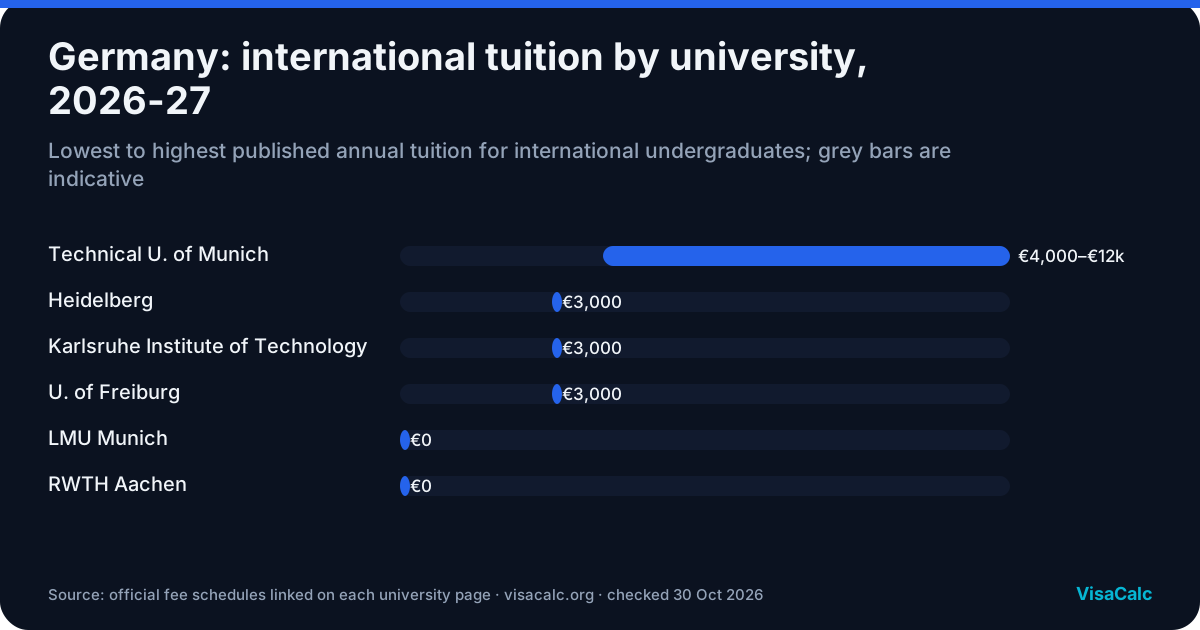
Worked example: cheapest vs most expensive degree
Using tuition plus the official visa living-cost figure for a 3-year bachelor's, with 2026-27 fees held flat and converted at 29 Oct 2026 rates:
| Scenario | Per year | 3-year total |
|---|---|---|
| Lowest fee we verified: LMU Munich | €11,904 | €35,712 ≈ ₹37.9 lakh |
| Highest fee we verified: Technical University of Munich (most expensive programme) | €23,904 | €71,712 ≈ ₹76.2 lakh |
The gap of about ₹38.2 lakh comes almost entirely from university and programme choice, which is why the programme fee matters more than the headline ranking. Scholarships are not deducted.
Unlike the UK, Australia, or USA, Germany's meaningful split isn't prestige-based — it's structural. Public universities are tuition-free for international students in 15 of 16 federal states (the exception: Baden-Württemberg charges €1,500/semester for non-EU students). The real decision tree is public vs private, and which city fits your budget.
The Tiers, Honestly
Public Research Universities (TU9 + Elite)
TU Munich, RWTH Aachen, KIT, TU Berlin, Humboldt Berlin, LMU Munich, Heidelberg. Tuition-free (semester fee €85-€400 only). Strong in engineering, natural sciences, and research — Germany produces some of Europe's top engineering graduates from these institutions.
Public Universities — Standard
The remaining ~380 German public universities and Fachhochschulen (universities of applied sciences). Also tuition-free. Applied sciences institutions focus more on practical training and industry placements than pure research.
Baden-Württemberg Public Universities
University of Stuttgart, Karlsruhe Institute of Technology, University of Freiburg. Same academic quality as other public universities, but charge non-EU students €1,500/semester (€3,000/year) — the one state-level exception to free tuition.
Private Universities
Jacobs University, Hertie School, and others. €5,000-€30,000+/year, up to €65,000 for some MBA programmes. Smaller class sizes, more English-taught programmes, stronger administrative support for internationals — but you're paying for what's free elsewhere.
The Real Cost Breakdown (2026)
| Tier | Cost |
|---|---|
| Public university tuition (15 of 16 states) | €0 — semester fee only (€85–€400) |
| Public university, Baden-Württemberg (non-EU) | €1,500/semester (€3,000/year) |
| Private university tuition | €5,000–€30,000/year |
| Blocked account requirement (Sperrkonto) | €11,904/year (€992/month, all applicants) |
The €11,904 blocked account is required regardless of which university type you choose — it's a visa financial-proof requirement, not a tuition fee.
💡 The Honest Reality
Most bachelor's programmes in Germany are taught in German and require C1-level proficiency (TestDaF 4-5 or DSH-2) — a real barrier that takes 12-18 months of language study most applicants underestimate. Master's programmes are the opposite: 2,000+ English-taught options exist across top public universities in engineering, CS, business, and life sciences, making the master's route far more accessible for non-German speakers.
What Should Actually Drive Your Decision
- Public university tuition-free status has held since 2014 and is politically stable — but Bavaria and other states have floated similar fees to Baden-Württemberg's, worth monitoring before a multi-year commitment
- Choose your city as carefully as your university — Munich costs €1,200-1,500/month, Leipzig or Dresden €800-1,000/month, a bigger swing than most tuition differences
- After graduation, the 18-month Job-Seeker visa lets you search for work at any salary level — one of the most flexible post-study visas globally, unlike the UK or US
- A private university's smaller class size and English-language support may be worth the cost if your German isn't C1-level and you need a bachelor's (not master's) programme
Frequently Asked Questions
Is German public university tuition really free for international students?
Almost always, but with two real exceptions worth knowing before you commit. Baden-Württemberg charges non-EU students €1,500/semester (€3,000/year) state-wide. Separately, TU Munich (TUM) introduced its own non-EU tuition from Winter Semester 2024/25 (€2,000–3,000 per semester for bachelor's and €4,000–6,000 for master's) despite Bavaria itself being a fee-free state — meaning even within a "free" state, one specific university can still charge. Always confirm the current fee on the university's own admissions page rather than assuming state-level rules apply universally.
Should I do a bachelor's or master's degree in Germany if I don't speak German?
A master's is far more accessible — over 2,000 English-taught master's programmes exist at top public universities, while most bachelor's programmes require C1-level German (typically 12-18 months of study to reach).
Is a private German university ever worth the cost when public is free?
It can be, specifically if your German isn't at C1 level and you need a bachelor's degree rather than a master's — private universities offer more English-taught bachelor's options and smaller class sizes, which is what you're actually paying the €5,000-30,000+/year for.
Does the type of university (public vs private) affect my path to permanent residence?
No — the settlement timeline (21 months with B1 German, 27 months with just A1, following a March 2024 reform) depends on your visa category and language level, not which university you attended. A cheaper public degree and an expensive private one lead to the identical immigration pathway.
How to cite this page
Chauhan, A. (VisaCalc). "Germany University Types 2026 — Public (Free) vs Private, Explained." VisaCalc. Last modified October 2026. https://visacalc.org/universities/germany-university-tiers.html