⏸️ Dropping or Repeating a Semester Abroad
What happens if you drop, defer or repeat a semester while studying in the USA, Canada, UK, Australia or Germany: visa rules, when you can return, costs, and the effect on internships, OPT, PGWP and jobs.
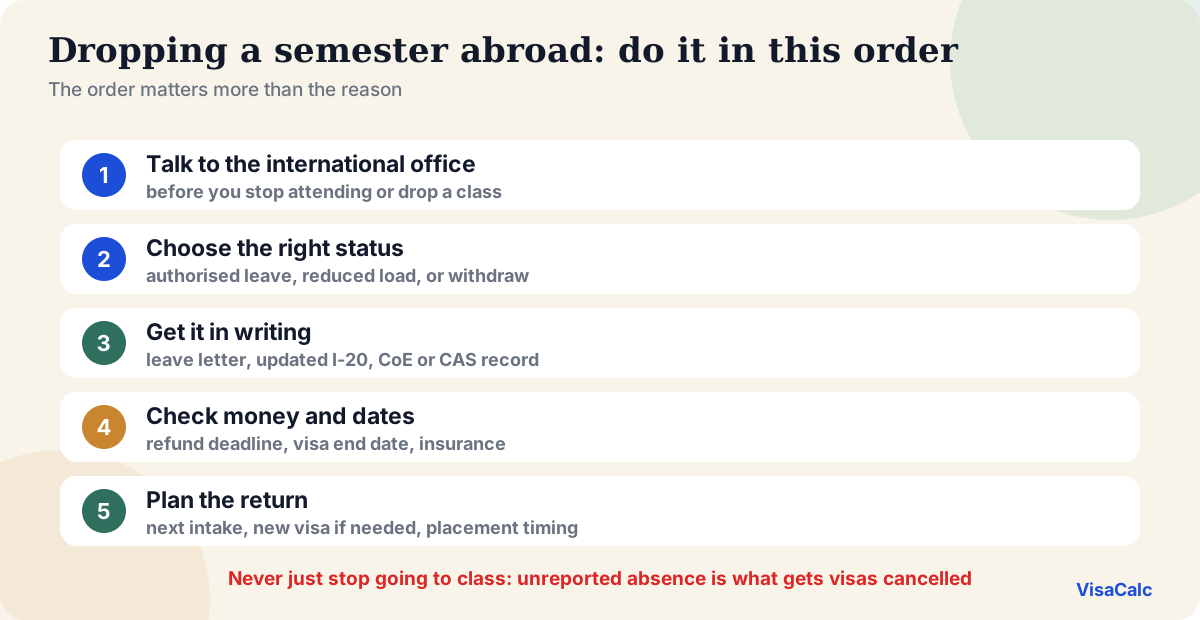
Before you drop anything: five steps
- Talk to the international student office first. In the US this is your DSO; in the UK your visa compliance team; in Canada, Australia and Germany the international office. They can often choose a status that keeps your visa alive.
- Pick the right tool. Dropping one course, a reduced load, an authorised leave and a full withdrawal have very different visa results.
- Get it in writing. A leave letter, an updated I-20, a PRISMS-updated CoE or the university's confirmation. You will need it for your next visa, PGWP or OPT application.
- Check money and dates. The tuition refund deadline (often only in the first weeks of term), your visa end date, health insurance, and your rental contract.
- Plan the return. The next intake, whether you need a new visa, and how internships, co-op or placement years line up.
Country rules side by side
Failing a course: withdraw, resit or repeat?
- Withdraw before the deadline. Most US and Canadian universities give a W or a non-graded withdrawal up to a published date; after it, you get the fail. A W does not lower your GPA.
- Keep full-time. If dropping one course takes you below full-time, ask about adding another course or a reduced-load authorisation first.
- UK resits. Many UK universities let you resit without attending. That usually means your sponsorship ends and you return home, then come back for the exam if eligible. Repeating a year with attendance needs a new CAS.
- Germany. Exams usually have a limited number of attempts, so plan a repeat with your examination office.
- Repeating a semester costs a semester of tuition and living costs, and in the US, UK and Australia often a new visa or I-20 as well. Scholarships may be suspended if you drop below full-time.
Worked example: a medical leave from a US master's
| Choice | What it costs and changes |
|---|---|
| RCL for medical reasons, staying in the US for one semester | SEVIS stays active, no new fees. You return full-time next semester; CPT and OPT eligibility is not reset. |
| Going home for 3 months with the DSO's approval | Return on the same I-20 within 5 months, provided the DSO kept the record active. |
| Going home for 7 months | New initial I-20, $350 SEVIS fee, $185 visa fee (plus the $250 visa integrity fee where charged) if your visa has expired, a 1 to 4 month interview wait in India, and a new full academic year before CPT or OPT. |
Will it affect placements and jobs?
A single paused semester rarely closes doors by itself. What it changes is timing and, if you failed courses, your grades:
- Graduation date moves. Internship and graduate recruiting runs on a calendar (US summer internships usually recruit in the autumn). Plan applications around your new date, not your old one.
- Post-study work clocks. OPT and CPT need a full academic year in status; Canada's PGWP needs full-time study apart from an authorised leave; the UK Graduate route needs successful completion; Australia's 485 needs 92 weeks of study.
- Co-op and placement years are tied to enrolment. Tell your co-op or placement office early so they can move you to the next cycle instead of cancelling.
- Background checks confirm dates and degrees. A short, honest explanation ("a medical leave, then completed the degree") is fine; an unexplained or misreported gap is not.
- Grades matter more than gaps. Some recruiters, including many campus recruiters in India, screen by GPA or by uncleared backlogs (failed courses not yet passed). Clearing failed courses quickly matters more than the break itself.
Studying in India now and planning to go abroad?
A dropped semester or a year back in India does not stop you studying abroad. Universities and visa officers mainly look for an explained gap: keep medical records, a letter from your college, or proof of what you did in the gap (work, a course, an internship). Many Indian applicants add a short signed statement explaining the gap. Unexplained gaps and inconsistent dates are what raise questions.
Frequently Asked Questions
Can an international student drop a semester?
Yes, but only through the right process. Each country has an approved way to pause: a Reduced Course Load in the US, an authorised leave of up to 150 days in Canada, an interruption (with a new visa to return) in the UK, a deferral or suspension for compassionate or compelling reasons in Australia, and a leave semester in Germany. Simply stopping attendance is what leads to cancelled visas.
What happens to my F-1 visa if I take a semester off?
If your DSO authorises a Reduced Course Load (for example for a medical condition, up to 12 months in total), your SEVIS record stays active. If you stop without authorisation, your record is usually terminated, and if you are outside the US for 5 months or more you need a new I-20, a new $350 SEVIS fee and a new full academic year before CPT or OPT.
Can I take a semester off in Canada and still get a PGWP?
Yes, if your school authorised the leave and it lasted no more than 150 days. Apart from that leave and your final semester, you must study full-time in every semester to stay eligible for the Post-Graduation Work Permit. You cannot work during the leave.
What happens to my UK Student visa if I interrupt my studies?
For anything beyond a short authorised absence, your university withdraws sponsorship and the Home Office curtails your visa. To return you need a new CAS and a new Student visa: £558 plus the £776 a year health surcharge.
Will a semester drop affect my placement or job?
Usually not by itself, if you can explain it. Employers mostly care that you finished, your grades and your skills. What a drop does change is timing: it can move your graduation, internship cycle, co-op term, OPT or PGWP dates. A failed grade affects your GPA more than an approved withdrawal does.
Is it better to withdraw or to fail a course?
If you are going to fail, withdrawing before your university's deadline is usually better: it often shows as a W or a non-graded withdrawal and does not lower your GPA. But for international students, dropping below full-time can affect your visa, so ask the international office first.
Sources
Figures on this page were checked against these sources on 3 November 2026. Rules change: confirm on the official site before you apply.
- Study in the States (DHS): reduced course load for F-1 and M-1 students
- MIT ISO: F-1 five-month temporary absence rule
- CIC News: full-time study, authorised leave and PGWP eligibility
- University of Exeter: withdrawing Student visa sponsorship
- Australian Department of Education: National Code Standard 9 (deferring, suspending or cancelling enrolment)
- Studentenwerk Leipzig: leave of absence FAQ for international students
- Insider Guides: Australian student visa fee from 1 July 2026