🇩🇪 Germany vs UK 🇬🇧 for Indian Students
Germany or UK for an Indian student? Funds to show in rupees, visa fees, work hours, post-study work after a 1-year or 2-year master's, and the route to PR, side by side.
The short answer
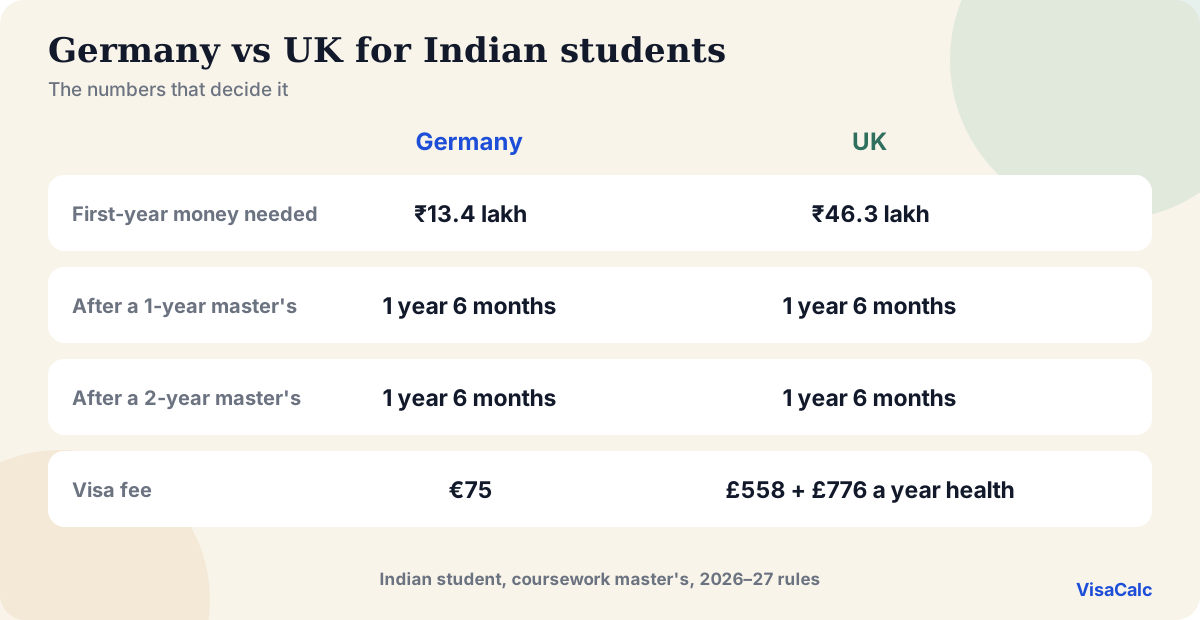
Germany's public universities charge almost no tuition (Baden-Württemberg charges non-EU students €1,500 a semester), and graduates get 18 months to find a job and a fast EU Blue Card route; the UK is much faster to finish (1-year master's) and needs no German, but costs far more.
Side by side
| 🇩🇪 Germany | 🇬🇧 UK | |
|---|---|---|
| First-year money needed: tuition + living + travel funds (example) | €12,604 ≈ ₹13.4 lakh | £36,539 ≈ ₹46.3 lakh |
| Example tuition | €700 a year (two semester contributions at a public university) | £26,000 a year (example: a one-year taught master's) |
| Visa fee | €75 | £558 + £776 a year health surcharge |
| Work while studying | 140 full or 280 half days a year | 20 hours a week in term; full-time in breaks |
| Typical pay | €13.9 an hour (statutory minimum wage from 1 January 2026; a mini-job pays up to €603 a month) | £12.71 an hour (National Living Wage for workers aged 21 and over from 1 April 2026) |
| Post-study work after a 1-year master's | 1 year 6 months | 1 year 6 months |
| Post-study work after a 2-year master's | 1 year 6 months | 1 year 6 months |
| English test | Course-dependent; German helps a lot for jobs | Some universities accept Class 12 English or their own assessment |
| Medical | None for the visa (health insurance needed) | TB test certificate |
| Route to permanent residence | 18-month job search → EU Blue Card → settlement after 21 months (with B1 German) or 27 months (with basic A1 German) | Graduate route → Skilled Worker → settlement (10-year baseline from 2027 under Earned Settlement; 5 years above £50,270) |
First-year money is example tuition plus the official living-cost funds (and travel money where required); the UK uses the outside-London rate, which rises to £1,203 a month for applications from 30 November 2026. Rupee values at approximate 29 October 2026 rates. Post-study work assumes an Indian graduate of a coursework master's applying in 2027.
Choose Germany if…
- You want to avoid tuition fees: about ₹13 lakh in the first year against over ₹45 lakh on our UK example
- You can learn German (it matters for most jobs) and do a 2-year master's
- You want a fast route to residence through the EU Blue Card
Choose the UK if…
- You want to finish in one year
- You want to work in English from day one
- You can afford higher fees for a shorter course
Work out your own numbers
Frequently Asked Questions
Is Germany or the UK better for Indian students?
Germany's public universities charge almost no tuition (Baden-Württemberg charges non-EU students €1,500 a semester), and graduates get 18 months to find a job and a fast EU Blue Card route; the UK is much faster to finish (1-year master's) and needs no German, but costs far more.
Which is cheaper, Germany or the UK?
On our example courses, Germany needs less money in the first year (tuition plus the living-cost funds you must show): Germany about ₹13.4 lakh and UK about ₹46.3 lakh at 29 October 2026 rates. Your own tuition changes this.
How long can I stay to find a job after a master's in Germany or the UK?
After a 1-year master's: Germany 1 year 6 months, UK 1 year 6 months. After a 2-year master's: Germany 1 year 6 months, UK 1 year 6 months (Indian graduate, applying in 2027).
How many hours can students work in Germany and the UK?
Germany: 140 full or 280 half days a year. UK: 20 hours a week in term; full-time in breaks.
Sources
Figures on this page were checked against these sources on 3 November 2026. Rules change: confirm on the official site before you apply.