🇫🇷 Study in France: The 2026 Journey, Step by Step
The full 2026 student journey to France: Campus France, €615 a month in funds, an OFII validation and 964 working hours a year. What visa officers check, what to pack to cut first-month costs, and how much part-time work really covers.
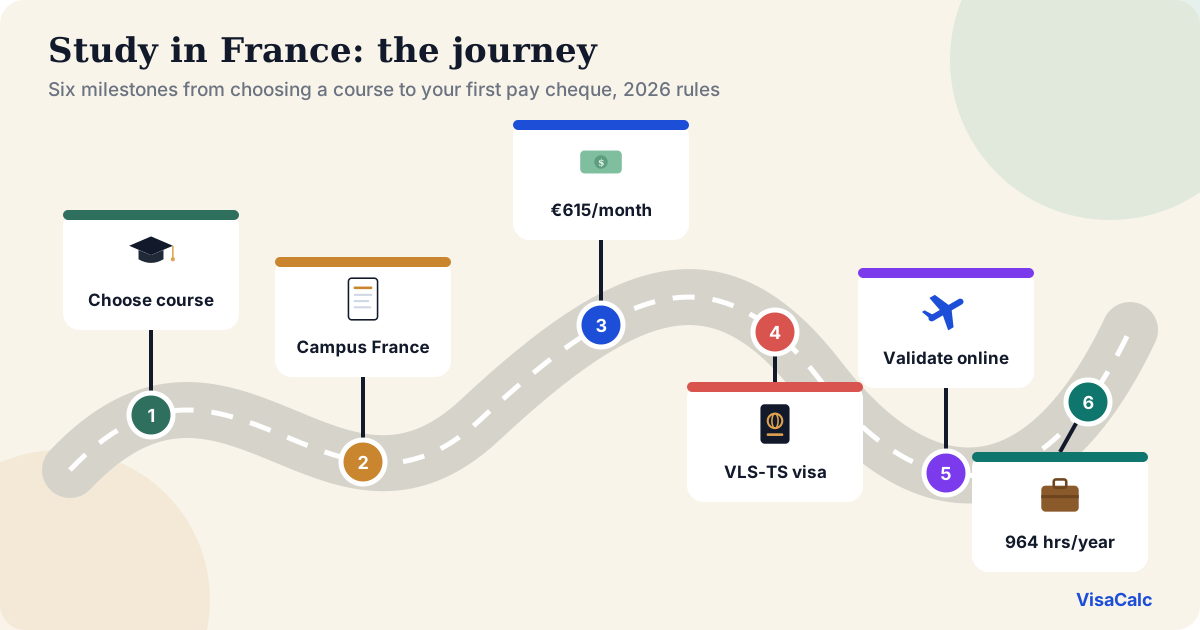
At a glance: the 2026 numbers
| What | France |
|---|---|
| Document you need from the school | admission letter, plus the Campus France "Études en France" process |
| Living costs to show | at least €615 a month (€7,380 a year) |
| Work in term | 964 h/year |
| Minimum wage | €12.31 an hour |
| Plugs and voltage | Type E plugs, 230 V |
| Cash to declare | €10,000 or more |
Step 1–8: the journey in order
Timings count back from your course start date. Start earlier if you need a scholarship or an education loan: both add months.
What the visa officer is looking for
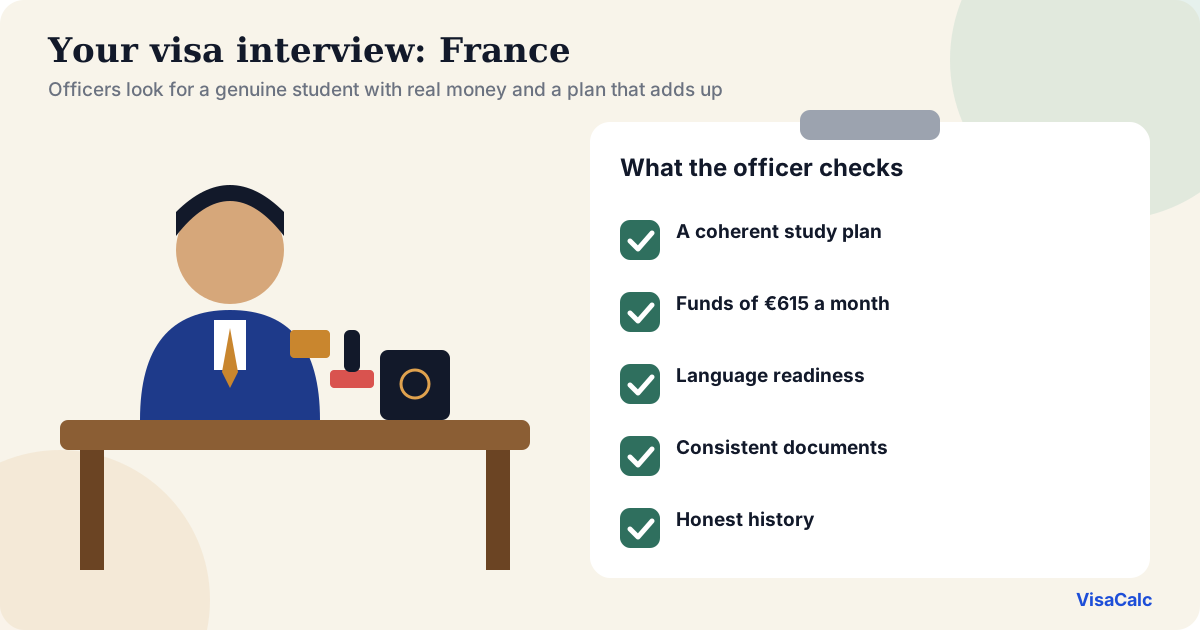
✅ A coherent study plan
Campus France interviewers ask why this course, why France and what comes next.
✅ Funds of €615 a month
Statements, a sponsor's guarantee or a scholarship letter.
✅ Language readiness
The level of English or French the course needs.
✅ Consistent documents
Transcripts and dates that match your application.
✅ Honest history
Past refusals disclosed.
Before you leave: pack to cut your first-month costs
The first month abroad is the most expensive: deposits, bedding, a phone plan, transport cards and kitchen basics all land at once. Packing the right things from home, and leaving the wrong ones behind, saves real money and trouble at the border. France runs on 230 V, so Indian appliances work with a Type E adapter.
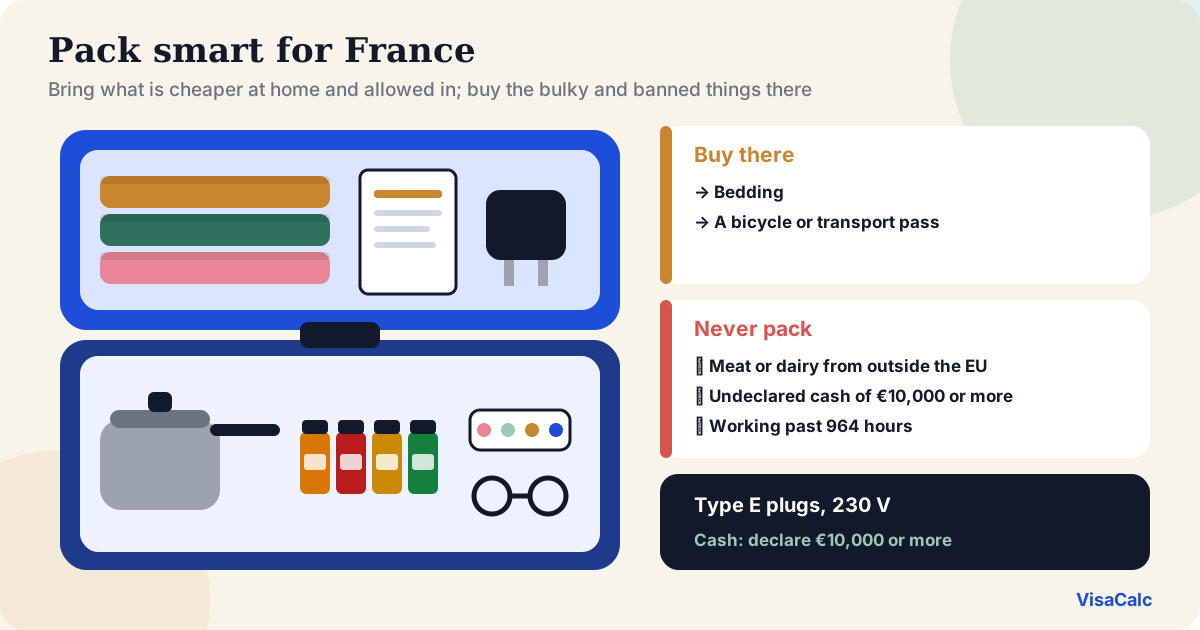
| Item | Why |
|---|---|
| ✅ Bring: Warm layers and a coat | northern and eastern France get cold |
| ✅ Bring: Pressure cooker and one heavy pan | cooking at home saves the most |
| ✅ Bring: Ground, sealed spices | allowed for personal use |
| ✅ Bring: Prescription medicines in original packs | with the prescription |
| ✅ Bring: Type E plug adapters | Indian 230 V appliances then work |
| ✅ Bring: Certified document copies and photos | for housing, bank and university files |
| 🛒 Buy there: Bedding | discount and second-hand stores |
| 🛒 Buy there: A bicycle or transport pass | student passes are discounted in most cities |
| ⛔ Never pack: Meat or dairy from outside the EU | banned for personal import into the EU |
| ⛔ Never pack: Undeclared cash of €10,000 or more | seizure and fines |
| ⛔ Never pack: Working past 964 hours | puts your residence permit at risk |
💵 Declare cash of €10,000 or more when you enter the EU. Use a forex card or a low-fee multi-currency account for most of your money, and carry only enough cash for the first few days. Full France customs rules →
Paying your fees by working, within the rules
| Rule | France in 2026 |
|---|---|
| During term | Up to 964 hours a year (60% of full-time), with no separate weekly cap in term |
| Breaks | Breaks count toward the same 964 hours a year |
| Minimum wage | €12.31 an hour (SMIC from 1 June 2026) |
| Maximum under the hour limit | €11,867 a year (964 hours) |
Worked example. A realistic plan is fewer hours than the legal maximum, because shifts are not always available and grades matter. Here is what 15 hours a week in term and 35 in breaks earns:
| Item | Amount |
|---|---|
| Term: 15 h/week × 30 weeks × €12.31 | €5,540 |
| Breaks: 35 h/week × 12 weeks × €12.31 | €5,170 |
| Gross earnings a year | €10,710 |
| Tuition (example: a master's at a public university at the differentiated fee) | €3,941 |
| Living costs (example living budget of €900 a month; the visa minimum is €615 a month) | €10,800 |
| Share of living costs covered | 99% |
| Share of tuition + living covered | 73% |
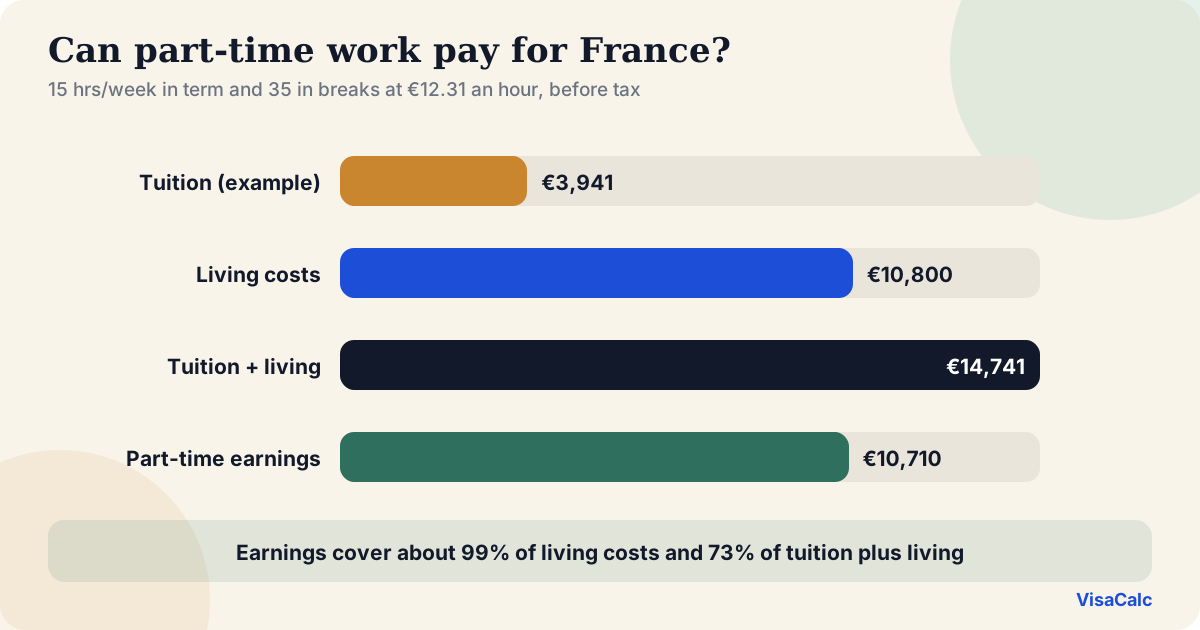
The pattern is the same everywhere: part-time work can cover much of your living costs, but rarely tuition. Plan to pay tuition from savings, a loan or a scholarship, and use wages for rent, food and the second year's buffer. Never go over your hour limit: breaching visa conditions can lead to cancellation and refusals later.
Other ways to bring the bill down
- Charpak scholarships for Indian students
- Eiffel Excellence scholarships for master's and PhD
- Paid internships (stages) that are part of your course
- Up to 964 hours a year of part-time work
Try your own numbers below. The legal-maximum button fills the most you are allowed to work.
Your first two weeks after landing
| Task | Why it matters |
|---|---|
| Validate the VLS-TS | within 3 months, online |
| Health insurance | register as a student |
| Bank account | needed for rent and wages |
| Phone and transport pass | student discounts apply |
Frequently Asked Questions
What are the steps to study in France?
1) Choose programmes. 2) Language tests. 3) Apply through Études en France. 4) Accept an offer and show funds. 5) Apply for the VLS-TS visa. 6) Validate your visa online. 7) Social security, bank, phone. 8) Work up to 964 hours a year.
What do visa officers look for in a France student visa application?
A coherent study plan: Campus France interviewers ask why this course, why France and what comes next. Funds of €615 a month: Statements, a sponsor's guarantee or a scholarship letter. Language readiness: The level of English or French the course needs.
Can I pay my tuition by working part-time in France?
Only partly. Working 15 hours a week in term and 35 in breaks at €12.31 an hour earns about €10,710 a year before tax, roughly 99% of the €10,800 living-cost figure. You must show the first year's funds before the visa is granted, so wages are for later years and living costs, not for getting the visa.
How many hours can international students work in France?
Up to 964 hours a year (60% of full-time), with no separate weekly cap in term. Breaks count toward the same 964 hours a year.
What should I pack to save money when moving to France?
Bring: warm layers and a coat; pressure cooker and one heavy pan; ground, sealed spices; prescription medicines in original packs; type E plug adapters. Buy there: bedding; a bicycle or transport pass.
How many hours can international students work in France?
Up to 964 hours a year, about 60% of a full-time year, with no separate permit. Your employer must declare you to the prefecture before you start.
Sources
Figures on this page were checked against these sources on 31 October 2026. Rules change: confirm on the official site before you apply.