Canada's New 33,000-Spot Accelerated PR Pathway for Work Permit Holders (2026-2027)

Worked example
| Scenario | Outcome |
|---|---|
| A welder in Brandon, Manitoba has a Manitoba PNP-based PR application in process and has lived there for 3 years. | They meet the profile IRCC describes and may be processed faster automatically; no separate application is needed. |
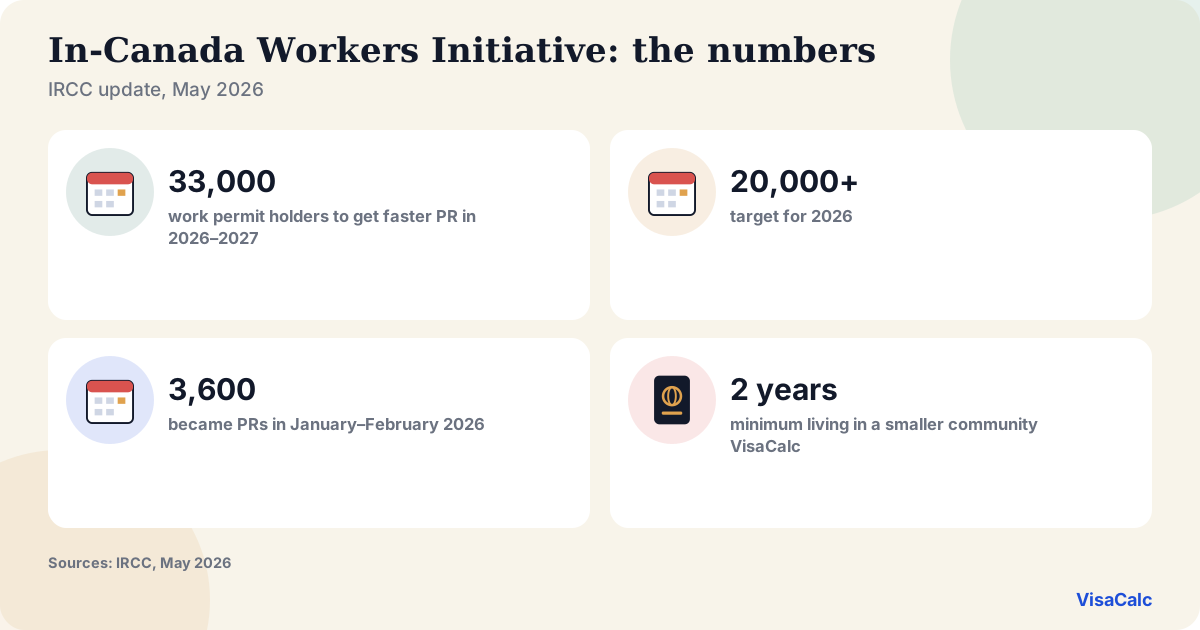
TL;DR: The In-Canada Workers Initiative fast-tracks permanent residence for up to 33,000 work permit holders in 2026 and 2027 (at least 20,000 in 2026). It is not a new application stream: IRCC speeds up permanent residence applications already in its queue from work permit holders who have lived at least two years in smaller communities and applied through a provincial nominee program, the Atlantic Immigration Program, a community or caregiver pilot, or the Agri-Food Pilot. You cannot apply to it directly (IRCC, May 2026).
What Is This New Pathway?
Buried inside Canada's Budget 2025 and confirmed in the 2026-2028 Immigration Levels Plan is a significant but under-the-radar announcement: a one-time accelerated measure to transition up to 33,000 work permit holders already in Canada to permanent residency over 2026 and 2027.
This is distinct from the regular Federal High Skilled (Express Entry) allocation of 109,000 and the Provincial Nominee Program allocation of 91,500 — it sits alongside these as an additional, targeted measure.
Who Is This For?
According to IRCC's May 2026 update, the initiative covers work permit holders who:
- already have a permanent residence application in IRCC's inventory through a provincial nominee program, the Atlantic Immigration Program, a community immigration pilot (such as the Rural Community Immigration Pilot), a caregiver pilot or the Agri-Food Pilot;
- have lived at least two years in a smaller Canadian community; and
- work in in-demand sectors in rural areas and communities with labour gaps.
How It Works in Practice
Earlier coverage (including the first version of this page) expected the measure to run through Express Entry. It does not. IRCC selects eligible cases from applications it already holds and processes them faster, and applicants do not need to take any action. From 1 January to 28 February 2026, 3,600 workers became permanent residents under it, and IRCC says it will publish progress monthly (IRCC, May 2026).
The practical consequence: if you are a work permit holder outside a big city, the way into this initiative is to get a permanent residence application in through one of the eligible provincial or pilot programs. Express Entry candidates are not part of it.
How This Compares to the Existing Canadian Experience Class
Canada already has a permanent pathway built specifically for people with Canadian work experience: the Canadian Experience Class (CEC), one of the three programs managed through Express Entry. CEC requires at least 1 year of skilled work experience (TEER 0-3) gained in Canada within the last 3 years, plus minimum language requirements (CLB 7 for TEER 0/1, CLB 5 for TEER 2/3). If you already qualify for CEC, you don't need to wait for details on the new 33,000-spot pathway — you can enter the Express Entry pool today.
The distinction is that CEC is a permanent, ongoing program, while the 33,000-spot measure is described as a one-time acceleration specifically layered on top of existing allocations — likely intended to clear a backlog of long-tenured work permit holders who haven't yet transitioned to PR, rather than replace or compete with CEC.
CRS Points From Canadian Work Experience
| Years of Canadian Work Experience | CRS Points (no spouse) | CRS Points (with spouse) |
|---|---|---|
| 1 year | 40 | 35 |
| 2 years | 53 | 46 |
| 3 years | 64 | 56 |
| 4 years | 72 | 63 |
| 5+ years | 80 | 70 |
These points stack with skill transferability bonuses if you also have strong language scores or a foreign credential — Canadian work experience combined with CLB 7+ language ability can add an additional 25-50 points beyond the core work experience points shown above.
The Rural Angle — Existing Pilots to Watch
The plan's emphasis on rural workers echoes Canada's existing Rural Community Immigration Pilot (RCIP) and the discontinued Rural and Northern Immigration Pilot before it — both designed to direct newcomers toward smaller communities facing acute labour shortages outside Toronto, Vancouver, and Montreal. If the new 33,000-spot measure follows a similar model, work permit holders already employed in a designated rural community may find themselves specifically prioritized once details are released.
What Work Permit Holders Should Do Now
- If you live outside a major city, look at your province's nominee streams and the Rural Community Immigration Pilot — an application through these is what makes you eligible for acceleration
- If you already have a PNP, AIP or pilot application in process, you do not need to do anything; keep your address, work permit and documents current
- If you are in a large city, this initiative is unlikely to apply; Canadian Experience Class rounds (cutoffs 507–523 in 2026) and provincial nomination remain the main routes
- Keep your work permit valid while your application is processed
❓ Frequently Asked Questions
What is Canada's accelerated PR pathway for work permit holders?
Announced in Budget 2025, this one-time measure will help up to 33,000 work permit holders in Canada transition to permanent residency during 2026 and 2027, with priority for those working in rural areas or high-demand sectors.
Who is eligible for the 33,000-spot accelerated pathway?
Work permit holders who have lived at least two years in a smaller Canadian community, work in an in-demand sector, and already have a permanent residence application in IRCC's queue through a provincial nominee program, the Atlantic Immigration Program, a community or caregiver pilot, or the Agri-Food Pilot (IRCC, May 2026).
When will applications open for this pathway?
There is no separate application. IRCC is speeding up eligible applications it already holds, and applicants do not need to take any action. 3,600 people became permanent residents under the initiative in January and February 2026, and the target is at least 20,000 in 2026.
How is this different from regular Express Entry?
It is not part of Express Entry. It accelerates applications already submitted through provincial and federal pilot programs for work permit holders in smaller communities, rather than inviting candidates from the Express Entry pool.
Sources
Figures on this page were checked against these official or primary sources on 30 October 2026.
Check your CRS score to compare your Express Entry options with provincial and pilot routes.
🇨🇦 Calculate My CRS Score 📊 Full 2026 Levels PlanHow to cite this page
Chauhan, A. (VisaCalc). "Canada's New 33,000-Spot Accelerated PR Pathway for Work Permit Holders." VisaCalc. Last modified October 2026. https://visacalc.org/blog/work-permit-accelerated-pr-pathway-2026.html