Complete Guide to Canada Express Entry 2026

Worked example: one CRS score, different outcomes
| Score and profile | 2026 outcome |
|---|---|
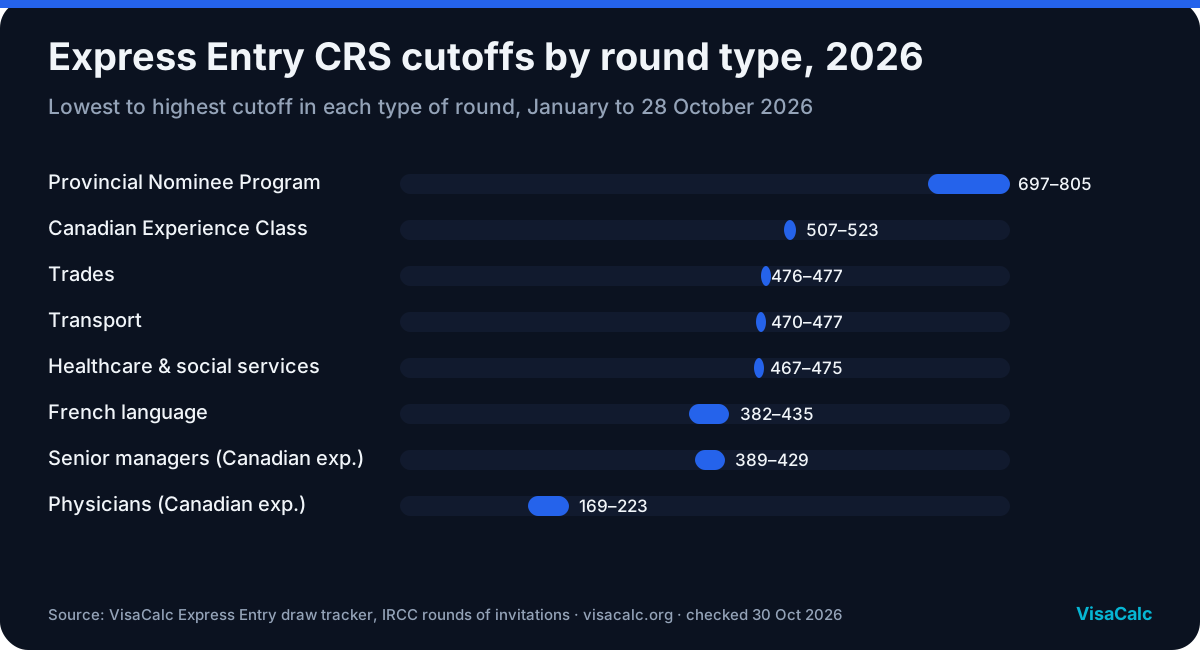
| 480, healthcare worker with 1 year of experience | Above healthcare cutoffs (467–475): likely invited |
| 480, software developer in Canada (CEC) | Below CEC cutoffs (507–523): not yet |
| 480 + provincial nomination = 1,080 | Invited in the next PNP round (697–805) |
| 420, French at NCLC 7 | Within French-round range (382–435) |
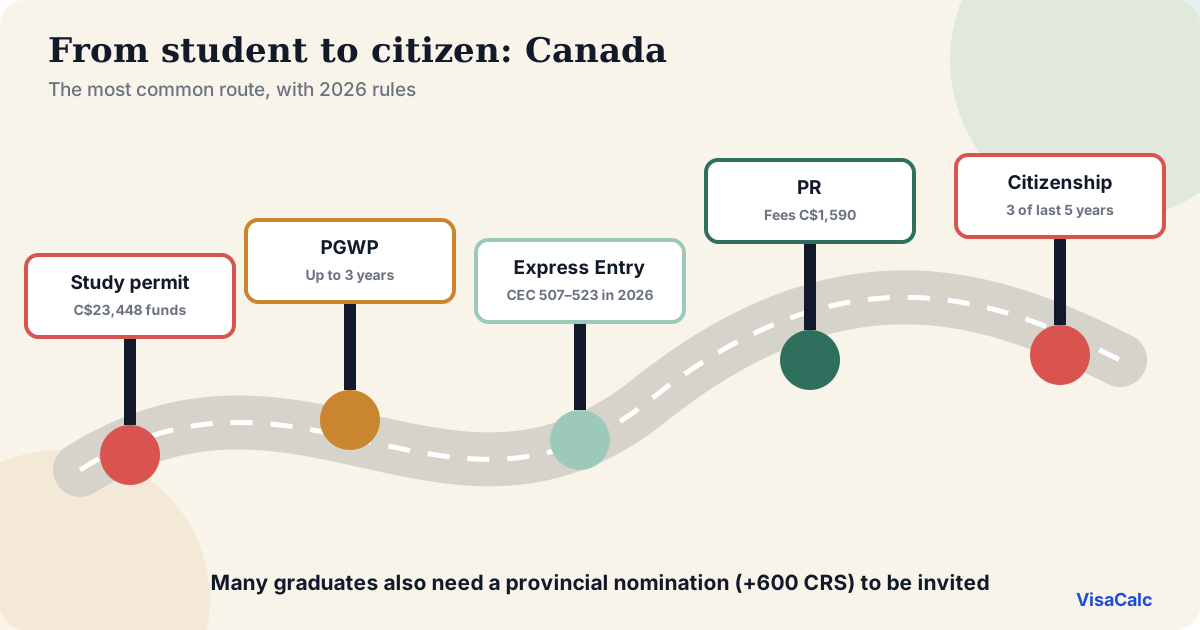
Quick summary: Canada Express Entry is a points-based immigration system. Your CRS score determines when you get invited to apply for permanent residence. In 2026 (to 28 October) IRCC has held no all-program draws. Canadian Experience Class rounds cut off at 507–523, French rounds at 382–435, and PNP rounds at 697–805 (including the 600 nomination points). These cutoffs were set before the 3 November 2026 scoring changes, which return job offer points for high-wage occupations; IRCC paused draws while it recalculates profiles.
What is Express Entry?
Express Entry is the Canadian government's main system for processing applications for skilled worker permanent residence, and one of several pathways covered on the Canada Immigration Hub. It manages three immigration programs: the Federal Skilled Worker Program (FSWP), Federal Skilled Trades Program (FSTP), and Canadian Experience Class (CEC).
You create an online profile, and if eligible, you enter a pool of candidates. IRCC holds rounds several times a month, usually targeted at a program (such as CEC or PNP) or a category (such as French or healthcare), inviting candidates with the highest Comprehensive Ranking System (CRS) scores to apply for permanent residence — track every draw as it happens on the Draw Tracker.
Step 1 — Check if You're Eligible
To enter the Express Entry pool, you must be eligible for at least one of the three programs. The Federal Skilled Worker Program requires a minimum of 67 points out of 100 based on: age, education, language skills (IELTS/CELPIP), work experience, arranged employment, and adaptability.
Sources
Figures on this page were checked against these official or primary sources on 30 October 2026.
Check your FSW 67-point eligibility before entering the Express Entry pool.
Check FSW 67 PointsStep 2 — Calculate Your CRS Score
Once in the pool, every candidate gets a CRS score out of 1,200. This score is based on: core human capital factors (age, education, language), Canadian work experience or a high-wage job offer (the Labour Market Integration factor, from 3 November 2026), spouse factors if applicable, skill transferability, and additional points (PNP nomination, French ability, Canadian education, sibling in Canada). From 3 November 2026 Canadian work experience and high-wage job offers are scored in a new Labour Market Integration factor worth up to 150 points.
Calculate your full CRS score now — see exactly where you stand in the pool.
🇨🇦 Calculate My CRS ScoreCRS Points Breakdown by Category
| Category | Max Points (no spouse) | Max Points (with spouse) |
|---|---|---|
| Core: Age, Education, Language, Canadian Experience | 500 | 460 |
| Spouse factors (education, language, Canadian experience) | — | 40 |
| Skill transferability (education + language/experience combos) | 100 | 100 |
| Additional points (PNP, French, Canadian education, sibling) | 600 | 600 |
| Total maximum | 1,200 | 1,200 |
Age points peak between 20 and 29 (110 points without a spouse, 100 with one) and decline steadily after 30, reaching zero at age 45. This is why many candidates in their late 30s and 40s rely more heavily on a PNP nomination or French to make up for lost age points.
2026 Express Entry Draw Cutoffs
| Round type (2026, to 28 Oct) | Rounds | Cutoff range |
|---|---|---|
| All programs (general) | 0 | None held in 2026 |
| Canadian Experience Class | 18 | 507–523 |
| Provincial Nominee Program | 21 | 697–805 (incl. 600) |
| French language proficiency | 12 | 382–435 |
| Healthcare & social services | 3 | 467–475 |
| Trade / transport occupations | 4 | 470–477 |
| Senior managers / physicians / military | 7 | 169–429 |
| STEM | 0 | None held in 2026 |
Source: IRCC rounds of invitations, compiled in our draw tracker.
Step 3 — How to Improve Your CRS Score
1. Improve your IELTS/CELPIP score — The biggest single improvement most people can make. Going from CLB 7 to CLB 9 in all four abilities adds 56 core points for a single applicant (17 → 31 per ability) and can unlock up to 50 more skill-transferability points.
2. Get a Provincial Nomination (PNP) — The most powerful CRS booster. A PNP nomination adds 600 points instantly — putting almost any candidate above the PNP round cutoff. Check which provinces match your profile.
3. Gain Canadian work experience — If you're on a work permit in Canada, each year of Canadian experience adds significant CRS points. 5+ years gives the maximum.
4. Complete a Canadian degree or diploma — A 3+ year program in Canada adds 30 additional points.
5. Learn French — NCLC 7+ in all four abilities adds 50 points (with CLB 5+ English) plus up to 24 second-language points, and qualifies you for French rounds. Note: from 3 November 2026 a job offer earns 50, 70 or 100 CRS points only in a high-wage occupation (no LMIA needed), and still helps with many PNP streams.
Timeline — From Profile to PR
Once you receive an Invitation to Apply (ITA), you have 60 days to submit a complete application. IRCC then typically processes most applications within 6 months. Total timeline from entering the pool to receiving PR is typically 8–18 months for most candidates — see the life-in-Canada guide for what happens after you land.
Ready to calculate your score? Our Canada CRS calculator is updated with the latest 2026 IRCC rules.
🇨🇦 Calculate My CRS Score 🏛️ Check PNP EligibilityDocuments You'll Need After an ITA
Once you receive an Invitation to Apply, IRCC expects a complete document package within 60 days. The core set includes:
- Passport — valid for the duration of processing, with clean pages for stamps
- Language test results — original IELTS/CELPIP report, not a photocopy
- Educational Credential Assessment — from a designated organization (WES is the most commonly used for degrees earned outside Canada)
- Proof of funds — bank letters showing unencumbered, liquid settlement funds for your family size, unless you already have valid Canadian work authorization
- Police certificates — from every country lived in for 6+ months since age 18, generally obtained after the ITA since most have a limited validity window
- Medical exam — from an IRCC-designated panel physician, usually completed after the ITA, valid for 12 months
- Work experience letters — on official letterhead, stating job title, duties, hours per week, salary, and dates, matching the NOC/TEER code claimed for points
Missing or mismatched documents are the single biggest cause of processing delays after an ITA — double-check that your work experience letters describe duties consistent with the NOC code you claimed points for, since discrepancies here are the most common reason for a request for additional information mid-processing.
Common Mistakes That Cost Candidates Points or Invitations
Letting language test results expire. IELTS and CELPIP results are valid for only 2 years from the test date — many candidates miss an invitation because their scores expired while they waited in the pool, silently dropping their CRS score to zero for that category.
Underestimating the ECA timeline. Educational Credential Assessments can take 4-8 weeks to process, and you can't get full education points without one. Starting this early avoids missing draws you'd otherwise qualify for.
Assuming any job offer adds CRS points. Only offers in high-wage occupations earn points (50, 70 or 100 from 3 November 2026), an LMIA adds nothing extra, and job offer points replace rather than add to your Canadian work points. Any offer can still open provincial nominee streams worth 600.
Ignoring category-based draws. Focusing only on the general draw cutoff means missing opportunities — Healthcare, STEM, French-language, and trades category draws regularly invite candidates well below the general pool's cutoff.
Frequently Asked Questions
How often are Express Entry draws held?
General draws are typically held every two weeks, though IRCC has run more frequent category-based draws in some months. Track the exact dates and cutoffs live on the Draw Tracker.
Can I re-enter the pool if my profile expires?
Yes. Express Entry profiles are valid for 1 year. If you haven't received an ITA, you can create a new profile immediately, though you'll need to re-verify your language test and ECA are still within their validity windows.
Does a job offer still help my CRS score?
Yes, from 3 November 2026, if it is in a high-wage occupation: it earns 50, 70 or 100 points depending on the occupation's median wage, with no LMIA needed. Offers in other occupations earn nothing, though many provincial nominee streams still require a job offer, and a nomination adds 600 points.
Is a PNP nomination the same as a job offer?
No. A PNP nomination adds 600 CRS points, while a job offer adds at most 100, and only in a high-wage occupation (from 3 November 2026). A job offer often helps you get a nomination in the first place.