🇺🇸 USA University Real Cost Guide 2026 — Tuition, Living & 6 Ways to Cut It
Total 4-year cost ranges from $120,000 to $350,000+. Here's the real breakdown by university type and how to bring it down.
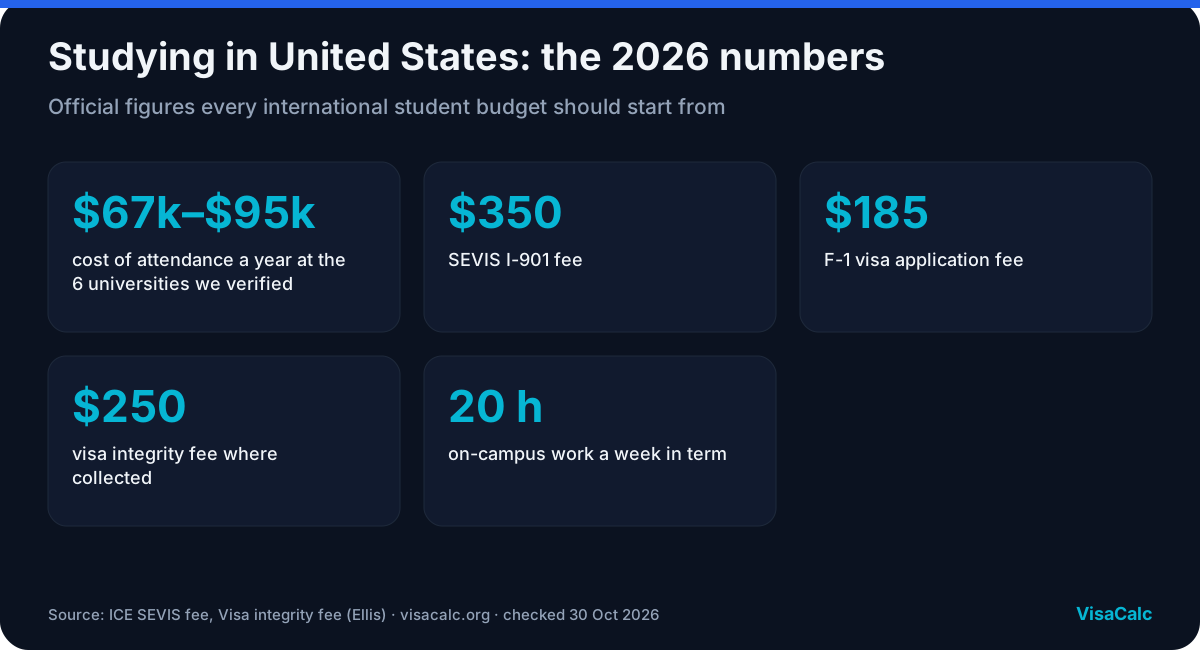
Worked example: cheapest vs most expensive degree
Using cost of attendance for a 4-year bachelor's, with 2026-27 fees held flat and converted at 29 Oct 2026 rates:
| Scenario | Per year | 4-year total |
|---|---|---|
| Lowest fee we verified: University of Michigan | $67,096 | $268,384 ≈ ₹2.56 crore |
| Highest fee we verified: Princeton University (most expensive programme) | $94,624 | $378,496 ≈ ₹3.61 crore |
The gap of about ₹1.05 crore comes almost entirely from university and programme choice, which is why the aid policy matters more than the headline ranking. Scholarships are not deducted.
Total cost for a 4-year US degree ranges from $120,000-$220,000 at a public university to $250,000-$350,000+ at a private one — the widest range of any country in this guide, which makes university selection the single biggest cost lever.
The Real Cost Breakdown (2026)
| Item | Cost |
|---|---|
| Public university (out-of-state/international) | $30,000–$60,000+/year tuition |
| Private university | $50,000–$80,000+/year tuition |
| Elite private (Harvard, MIT, Stanford tier) | $60,000–$70,000/year tuition (before aid) |
| Living costs, urban (NYC, Boston, LA) | $16,000–$20,000/year |
| Living costs, rural/smaller city | $10,000–$14,000/year |
| Personal exemption for returning residents (unrelated to tuition) | $800 (customs, not tuition-related) |
5 Proven Strategies to Cut Your Total Cost
1Apply to need-aware private universities with strong international aid
A handful of elite privates offer generous — occasionally need-blind — aid to international students, which can make a $70,000/year sticker price cheaper than a public out-of-state option.
2Target flagship state R1 universities over private mid-tier
University of Michigan, UCLA, UC Berkeley offer strong research output and employer recognition at 40-60% of typical private university cost.
3Choose a smaller city for living costs
The gap between NYC/Boston/LA and a smaller college town can be $6,000-8,000/year — meaningful over a 4-year degree.
4Prioritize STEM fields for OPT extension value
STEM OPT gives 3 total H-1B lottery attempts vs 1 for non-STEM — this materially improves your odds of using your degree to work in the US post-graduation, changing the entire ROI calculation.
5Plan around the Change of Status exemption to the $100,000 H-1B fee
The single biggest hidden cost lever in 2026: Status check (29 October 2026): the $100,000 payment is currently not being enforced after two federal courts vacated it (D. Mass. 8 June 2026; N.D. Cal. 30 September 2026). Appeals are pending, so it could return. the new $100,000 H-1B fee applies to petitions for beneficiaries abroad, but not to Change of Status filings for people already legally present in the US on F-1 OPT, J-1, or TN status. Staying in-status through OPT while your employer files for Change of Status, rather than leaving the US and re-entering on a fresh H-1B, can be the difference between your employer absorbing a $100,000 fee or not — a factor genuinely worth planning your post-graduation timeline around.
6Check real H-1B sponsorship data before committing to a career path
Use MyVisaJobs.com or H1Bdata.info to see which employers and fields have real sponsorship volume — this should influence your major choice as much as your university choice in 2026's tighter visa environment.
⚠️ Reality Check
With the February 2026 wage-weighted H-1B lottery giving entry-level candidates only ~15% selection odds, and a new $100,000 employer fee on new petitions filed from abroad, the value of a US degree is increasingly tied to your field and post-study work strategy — not just your university's prestige. The wage-level gradient is stark: DHS projects roughly 15% odds at Level I (entry), 31% at Level II, 46% at Level III, and 61% at Level IV — a genuinely large spread that rewards targeting higher-wage-level roles specifically, not just any H-1B-sponsoring employer.
Frequently Asked Questions
Is a flagship state university really cheaper than a private one for international students?
Often significantly so — schools like University of Michigan, UCLA, and UC Berkeley offer strong research output and employer recognition at roughly 40-60% of typical private university cost, without the aid uncertainty many privates carry for international applicants.
Should I pick my major based on H-1B sponsorship data?
It's increasingly worth weighing alongside prestige. With entry-level H-1B selection odds around 15% under the current wage-weighted lottery, checking real sponsorship volume by field (via MyVisaJobs.com or H1Bdata.info) before committing can meaningfully change your post-graduation odds.
Does STEM OPT actually matter for the total cost calculation?
Yes, indirectly but significantly — STEM OPT gives you up to 3 total H-1B lottery attempts instead of 1, which materially improves your odds of actually using your US degree to work in the US afterward, changing the entire return-on-investment picture for the degree itself.
Does the $100,000 H-1B fee apply to me if I'm already studying in the US?
No — the fee applies to petitions for beneficiaries abroad, not to Change of Status filings for people already legally present on F-1 OPT, J-1, or TN status. Staying in-status through OPT while your employer files for Change of Status, rather than leaving and re-entering on a fresh H-1B, is the single biggest hidden lever for avoiding this fee entirely.
How to cite this page
Chauhan, A. (VisaCalc). "USA University Real Cost Guide 2026 — Tuition, Living & 6 Ways to Cut It." VisaCalc. Last modified October 2026. https://visacalc.org/universities/usa-university-costs.html