🇬🇧 UK University Tiers 2026 — Russell Group vs Post-92 Explained
Russell Group status doesn't automatically mean a better outcome for your specific course. Here's an honest breakdown of the UK's real university tiers.
Worked example: cheapest vs most expensive degree
Using tuition plus the official visa living-cost figure for a 3-year bachelor's, with 2026-27 fees held flat and converted at 29 Oct 2026 rates:
| Scenario | Per year | 3-year total |
|---|---|---|
| Lowest fee we verified: London School of Economics | £43,030 | £129,090 ≈ ₹1.64 crore |
| Highest fee we verified: University of Cambridge (most expensive programme) | £81,381 | £244,143 ≈ ₹3.10 crore |
The gap of about ₹1.46 crore comes almost entirely from university and programme choice, which is why the programme fee matters more than the headline ranking. Scholarships are not deducted.
The UK higher education system splits broadly into the Russell Group (24 research-intensive universities) and post-92 institutions (roughly 90 universities that gained university status after 1992, formerly polytechnics). This distinction is the UK's rough equivalent of Ivy League vs state school — but it matters less than most applicants think.
The Tiers, Honestly
Tier 1 — Russell Group (Global Elite)
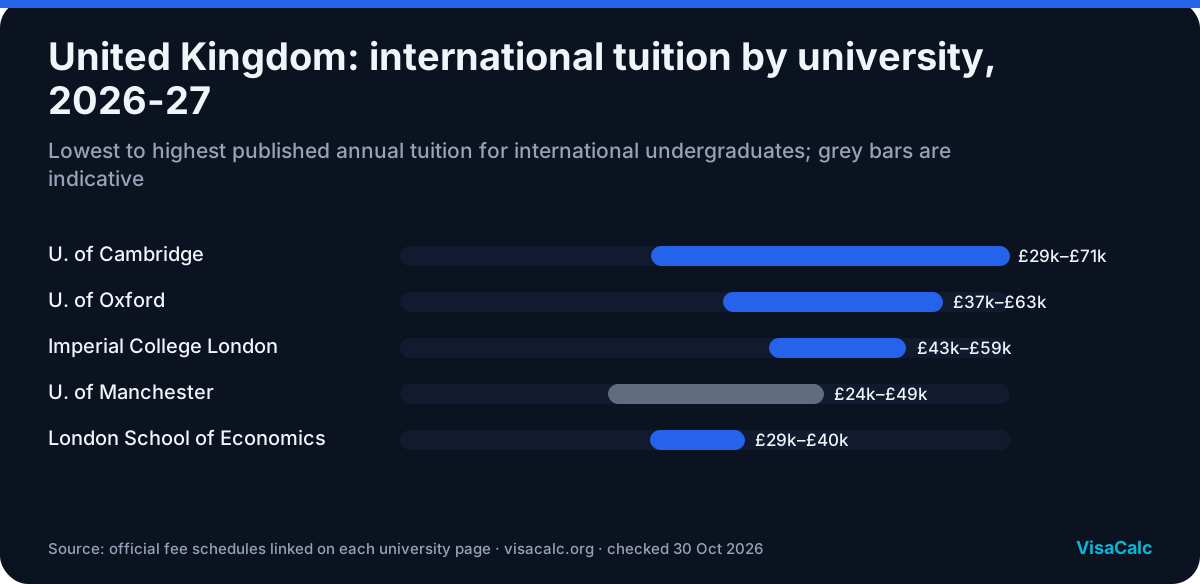
Oxford, Cambridge, Imperial College London, LSE, UCL. QS World Top 20. Highly selective (10-16% acceptance). International fees run from about £28,900 (LSE) to over £70,000 (Cambridge Medicine) a year for 2026-27, depending on course. Best for: research-heavy subjects, finance, consulting, law, academia. (LSE profile)
Tier 2 — Russell Group (Strong Regional)
Manchester, Edinburgh, King's College London, Bristol, Warwick, Birmingham, Leeds, Glasgow. QS Top 100-150. Acceptance 25-50%. International fees £22,000-£40,000/year. Strong industry links, good graduate outcomes across most fields.
Tier 3 — Russell Group (Best Value)
Queen's Belfast (from £19,100/year, the cheapest Russell Group option), Cardiff, Newcastle, Liverpool, Southampton. Acceptance 50-75%. Same Russell Group research funding access, significantly lower living costs outside London.
Post-92 Specialists
Coventry (automotive engineering), Bayes/City (business), SOAS (Asian & African studies). Not Russell Group, but outperform many Russell Group members in specific fields. Focus on applied research and industry placements over academic prestige.
Tuition Reality Check (International Students, 2026)
| Tier | Cost |
|---|---|
| Russell Group — most affordable (Queen's Belfast) | £19,100–£44,200/year |
| Russell Group — mid-range (Manchester, Leeds, Glasgow) | £22,000–£40,000/year |
| Russell Group — top tier (Oxbridge, Imperial, LSE) | £28,900–£70,554/year (2026-27: LSE from £28,900, Oxford £37,380–62,820, Imperial £42,700–58,600, Cambridge up to £70,554 for Medicine plus a £11,500 college fee) |
| Post-92 universities (national average) | £15,000–£25,000/year |
Tuition is often identical or lower at post-92 universities than mid-tier Russell Group — the real cost difference usually comes from location (London vs elsewhere), not tier.
💡 The Honest Reality
Russell Group status is a research funding designation, not an internal ranking — there's no official #1 to #24. A Coventry University automotive engineering graduate often has better industry outcomes than a Russell Group graduate in an unrelated field from a lower-demand course. Match the course strength to your career goal, not the group label.
What Should Actually Drive Your Decision
- Course-specific ranking matters more than institution-wide ranking — check subject tables, not overall league position
- London-based Russell Group universities (UCL, Imperial, KCL, LSE, QMUL) cost £1,400-£2,000/month in living expenses — often more than the tuition gap to a regional university
- Graduate Route visa (2 years post-study work, dropping to 18 months for applications from 1 Jan 2027) applies equally regardless of tier
- Employer preference for Russell Group is real but sector-specific — heaviest in consulting, finance, law; much weaker in creative industries, teaching, and applied engineering
- Entry grade expectations scale sharply by tier: A*A*A/A*AA for Oxford, Cambridge, Imperial and LSE; AAA-ABB for UCL, Edinburgh and King's; BBB-ABB for more accessible Russell Group members like York and Cardiff — check the specific course page, since requirements vary within the same university
- All UK Student visa holders, regardless of tier, can work up to 20 hours/week during term time and full-time during official vacations — at the current £12.71/hour national living wage (effective April 2026), that's roughly £1,000+/month gross before tax, a meaningful but not London-cost-covering supplement
How to cite this page
Chauhan, A. (VisaCalc). "UK University Tiers 2026 — Russell Group vs Post-92 Explained." VisaCalc. Last modified August 22, 2026. https://visacalc.org/universities/uk-university-tiers.html
Frequently Asked Questions
Does Russell Group membership guarantee a better job outcome?
No — it's a research funding designation, not a quality ranking of every course. Employer preference for Russell Group is real but sector-specific (strongest in consulting, finance, law), and a strong post-92 course in a specialist field can outperform a weak-fit Russell Group course.
Is a post-92 university's degree taken less seriously?
It depends heavily on the specific course and field. Post-92 specialists like Coventry (automotive engineering) or Bayes/City (business) outperform many Russell Group members in their specific subject, since their focus is applied research and industry placement rather than general academic prestige.
Why is location a bigger cost factor than university tier?
Tuition is often identical or lower at post-92 universities than mid-tier Russell Group institutions — the real cost gap usually comes from living expenses, with London-based universities running £1,400-£2,000/month versus considerably less in regional cities.
Do entry grade requirements vary a lot within the Russell Group?
Yes, significantly — Oxford, Cambridge, Imperial and LSE typically expect A*A*A or A*AA, while UCL, Edinburgh and King's sit closer to AAA-ABB, and more accessible members like York or Cardiff may accept BBB-ABB. Always check the specific course page rather than assuming one grade profile applies across the whole group.