🇩🇪 Karlsruhe Institute of Technology — Tuition, Scholarships & Visa Pathway for International Students
QS 2027 #110 · €3,000 a year · Karlsruhe
Quick Facts
| Location | Karlsruhe, Baden-Württemberg, Germany |
|---|---|
| Global Ranking | #110 in the QS World University Rankings 2027 (published June 2026). |
| International Students | Part of a 25,000-student body; over 90% of KIT graduates find employment within 6 months of completing their studies, with alumni working in 100+ countries. |
| English Requirement | Varies by programme; English-taught master's programmes typically require IELTS 6.5+ |
KIT's QS position (#110) actually sits well above its THE ranking (#166) — a 56-place gap that reflects stronger employer reputation than research-citation counts specifically. If you're weighing KIT primarily on employability versus pure research output, that gap matters: QS's methodology is the more relevant signal for graduate hiring prospects.
Tuition for International Students (2026-27)
€3,000 per year (Non-EU fee: €1,500 per semester (Baden-Württemberg), plus the semester contribution). Source: MSinGermany: non-EU tuition tracker by state, 2026, checked 30 October 2026. Add at least €11,904 a year for living costs (study visa minimum; source below).
Real Scholarships — Not Just a List of Names
DAAD Scholarships
Available to KIT applicants based on home country and field of study, same as other German public universities.
KIT research assistantships (HiWi)
Common funding route for master's and PhD students working within KIT's extensive research institutes, particularly in engineering and materials science.
A History of Real Engineering Breakthroughs
KIT's engineering pedigree isn't just marketing language — its alumni include Karl Benz, who designed the Benz Patent Motorcar widely considered the first practical automobile, and Karl Ferdinand Braun, who developed the cathode ray tube later used in televisions worldwide. The institute counts 6 Nobel laureates among its history, including Fritz Haber (Chemistry, 1918) and Hermann Staudinger (Chemistry, 1953). Chemical engineering is KIT's single highest-ranked subject globally, and it places among the world's top 50 engineering programmes on several independent rankings — a genuinely strong, checkable signal for engineering-focused applicants specifically, even as the overall institutional rank has softened slightly.
Visa & Post-Study Work Pathway
Even with the Baden-Württemberg non-EU fee, KIT remains dramatically cheaper than equivalent-ranked engineering programs in the UK, US or Australia — and its engineering research output is genuinely top-tier in Europe.
❓ Frequently Asked Questions
Is KIT good for international students?
Karlsruhe Institute of Technology is ranked #110 in the QS World University Rankings 2027, 5th of the 6 universities in Germany covered on VisaCalc. International tuition is about €3,000 a year. After graduating: 18-month residence permit to look for work after graduating. Whether it is a good fit depends on your program, budget and career plans; use the cost calculator and comparison charts on this page.
What tuition does KIT charge international students?
€3,000 per year (Non-EU fee: €1,500 per semester (Baden-Württemberg), plus the semester contribution), checked 30 October 2026.
What IELTS score do I need for KIT?
Varies by programme; English-taught master's programmes typically require IELTS 6.5+
Can I work in Germany after graduating from KIT?
Yes — KIT engineering graduates are eligible for Germany's 18-month Job-Seeker visa, and the field's shortage-occupation status typically qualifies for the lower €45,934.20 EU Blue Card salary threshold rather than the €50,700 standard rate.
Does KIT's declining overall ranking mean its engineering programs got weaker?
Not necessarily — chemical engineering remains KIT's single highest-ranked subject globally, placing among the world's top 50 engineering programmes on independent rankings. A modest slip in the composite overall rank doesn't reflect the same trend in every department, particularly for a historically strong engineering institution with 6 Nobel laureates and alumni including Karl Benz and Karl Ferdinand Braun.
See the full Germany university landscape and visa pathway.
🇩🇪 Germany University Types Guide 🔗 Official KIT Website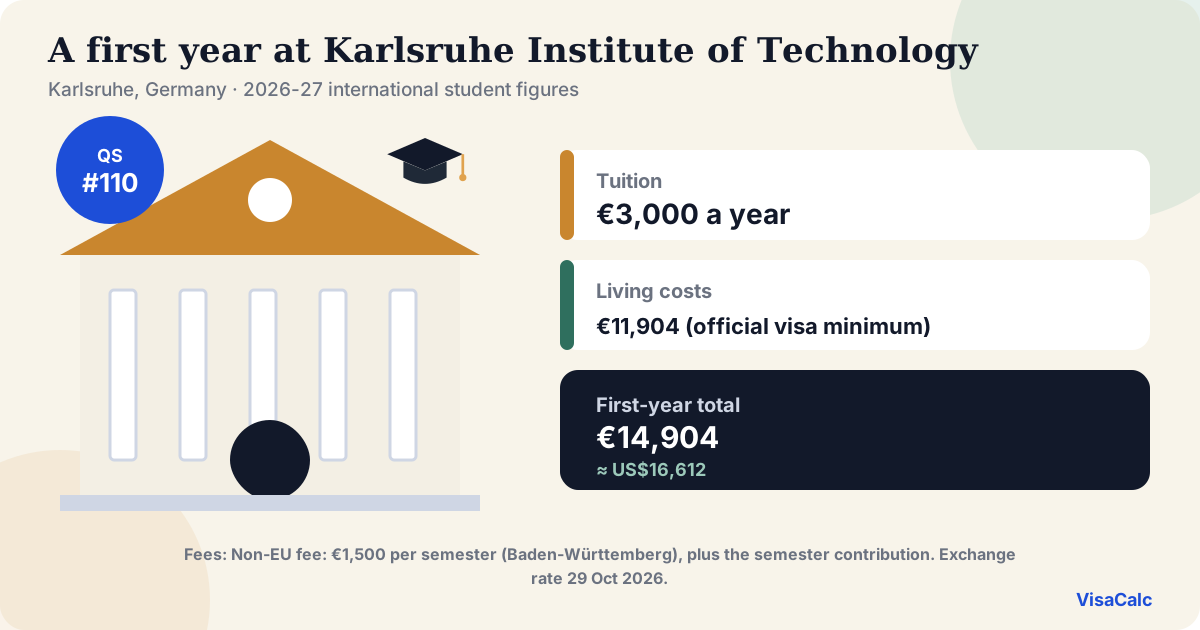
Worked example: a full degree at Karlsruhe Institute of Technology
An international student starting a 3-year bachelor's at the lowest fee shown, budgeting the official visa living-cost figure. Rates are converted at the 29 Oct 2026 reference rates; use the calculator above to change any assumption.
| Tuition | €3,000 a year (Non-EU fee: €1,500 per semester (Baden-Württemberg), plus the semester contribution) |
| Living costs | €11,904 a year (Blocked account (Sperrkonto) requirement for 2026: €992/month) |
| Years | 3 (typical bachelor's length) |
| Total, fees flat | €44,712 ≈ ₹47.5 lakh ≈ $49,835 |
| Total if costs rise 4% a year | €46,524 ≈ ₹49.4 lakh |
The visa living-cost figure is a legal minimum, not a comfortable budget. Scholarships are not deducted.
Sources
- MSinGermany: non-EU tuition tracker by state, 2026
- German Consulate Vancouver: QS 2027 results for Germany
- Prodigy Finance: German blocked account 2026 (€11,904)
- Exchange rates: open.er-api.com reference rates, 29 Oct 2026
How we checked this page
Fees for Karlsruhe Institute of Technology come from the MSinGermany: non-EU tuition tracker by state, 2026; the QS 2027 position from German Consulate Vancouver: QS 2027 results for Germany; living costs from Prodigy Finance: German blocked account 2026 (€11,904). Checked on 30 October 2026. Course-level fees vary, so confirm your exact program on the official Karlsruhe Institute of Technology website before paying anything. VisaCalc is independent of Karlsruhe Institute of Technology. Not admissions or immigration advice.