🇩🇪 Germany University Real Cost Guide 2026 — Free Tuition & the Real Numbers
Public university tuition is €0. Here's what you'll actually spend — and 5 ways experienced students bring the total down.
Worked example: cheapest vs most expensive degree
Using tuition plus the official visa living-cost figure for a 3-year bachelor's, with 2026-27 fees held flat and converted at 29 Oct 2026 rates:
| Scenario | Per year | 3-year total |
|---|---|---|
| Lowest fee we verified: LMU Munich | €11,904 | €35,712 ≈ ₹37.9 lakh |
| Highest fee we verified: Technical University of Munich (most expensive programme) | €23,904 | €71,712 ≈ ₹76.2 lakh |
The gap of about ₹38.2 lakh comes almost entirely from university and programme choice, which is why the programme fee matters more than the headline ranking. Scholarships are not deducted.
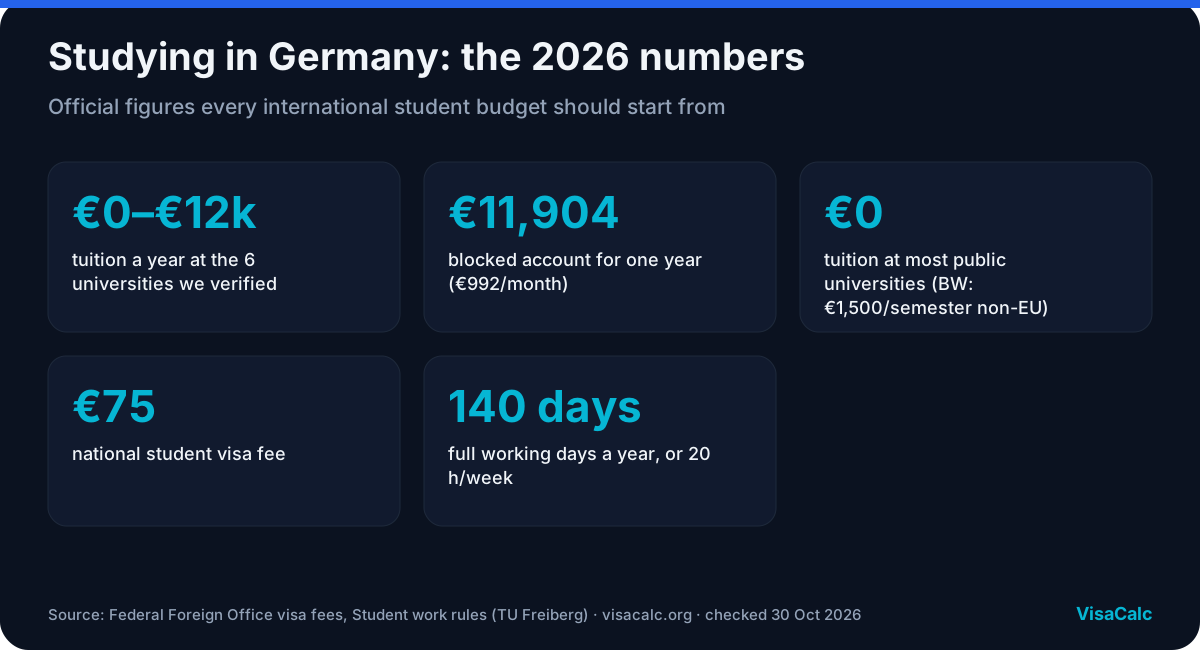
Total annual cost at a public German university is roughly €11,000–€13,000/year — almost entirely living expenses, since tuition itself is free in 15 of 16 states. This is the lowest total cost of any country in this guide.
The Real Cost Breakdown (2026)
| Item | Cost |
|---|---|
| Public university tuition (15 of 16 states) | €0 (semester fee €85–€400 only) |
| Public university, Baden-Württemberg (non-EU) | €1,500/semester (€3,000/year) |
| Blocked account requirement — mandatory for all | €11,904/year (€992/month) |
| Living costs, Munich/Frankfurt (most expensive) | €1,200–€1,500/month |
| Living costs, Leipzig/Dresden (most affordable) | €800–€1,000/month |
| Health insurance, public student rate (under 30) | €110–€150/month |
| Health insurance, once you turn 30 | €210–€300/month — the student discount ends entirely |
One genuine piece of hidden value the total-cost table doesn't capture: your semester fee typically bundles a Semesterticket, giving you free public transport across your city (and often the wider region) for the entire semester — a real saving of €80-100/month that most cost comparisons with other countries don't account for.
5 Proven Strategies to Cut Your Total Cost
1Study in Leipzig or Dresden instead of Munich
This single choice saves approximately €500/month — over €6,000/year — with no difference in tuition since public university is free everywhere except Baden-Württemberg.
2Avoid Baden-Württemberg unless the specific program justifies it
University of Stuttgart, KIT, and Freiburg are excellent, but the €3,000/year non-EU fee is avoidable at dozens of equally strong public universities in other states.
3Work the legal maximum — 140 full or 280 half days/year, or 20 hours a week
At Germany's €13.90 minimum wage (2026), 20 hours a week during the semester earns about €1,200/month before deductions, more than the €992 monthly blocked-account release.
4Look for a HiWi (research assistant) position
University research-assistant roles pay €14-16/hour and count as relevant work experience on your CV — better value than generic part-time work for both income and career capital.
5Set up your blocked account through a reputable BaFin-regulated provider
Cheap or unofficial 'blocked account' services are a common source of visa delays and fraud risk — see our Germany Fraud Warning page before choosing a provider. Note that Coracle stopped accepting new Sperrkonto applications in August 2025; Expatrio and Fintiba remain the two most commonly used providers as of 2026.
⚠️ Reality Check
The blocked account (€11,904/year) is often mistaken for a fee, but it's your own money, released to you monthly — it's a financial-proof requirement, not a cost. Your real annual spend is closer to €9,000-13,000 depending on city, not the full blocked account figure.
Frequently Asked Questions
Is the blocked account amount the same every year?
No — it's tied to Germany's BAföG student-aid reference rate and reviewed annually by the Federal Foreign Office. The €992/month (€11,904/year) figure has held steady since 2025 into 2026, but always verify the current figure at auswaertiges-amt.de before opening an account.
Which blocked account providers are still accepting new applications?
Coracle stopped accepting new Sperrkonto applications in August 2025. Expatrio and Fintiba remain the two most commonly used, BaFin-regulated providers as of 2026 — always verify current provider status before applying, since this can change.
Is €992/month actually enough to live on in Germany?
It depends heavily on the city. In Leipzig or Dresden it's generally adequate for modest student living. In Munich or Frankfurt, real costs commonly run €1,200-1,500/month — meaningfully above the blocked account minimum, so budget accordingly rather than assuming the visa minimum covers your actual expenses.
Does health insurance really get more expensive once I turn 30?
Yes, significantly — the discounted student public health insurance rate (roughly €110-150/month) ends at the conclusion of the semester in which you turn 30, and you must switch to voluntary public insurance (around €210-300/month) or private insurance. This is a real financial cliff worth planning around, especially for older master's or PhD applicants, though extensions are sometimes possible if documented delays (illness, family circumstances) affected your studies.
How to cite this page
Chauhan, A. (VisaCalc). "Germany University Real Cost Guide 2026 — Free Tuition & the Real Numbers." VisaCalc. Last modified October 2026. https://visacalc.org/universities/germany-university-costs.html