💰 Real Cost of Studying in Canada 2026 — Full Breakdown & Savings Strategies
The complete, honest cost breakdown — tuition, living expenses, hidden fees — plus proven strategies that can cut your total spend by CAD $50,000-150,000 over a 4-year degree.
Worked example: cheapest vs most expensive degree
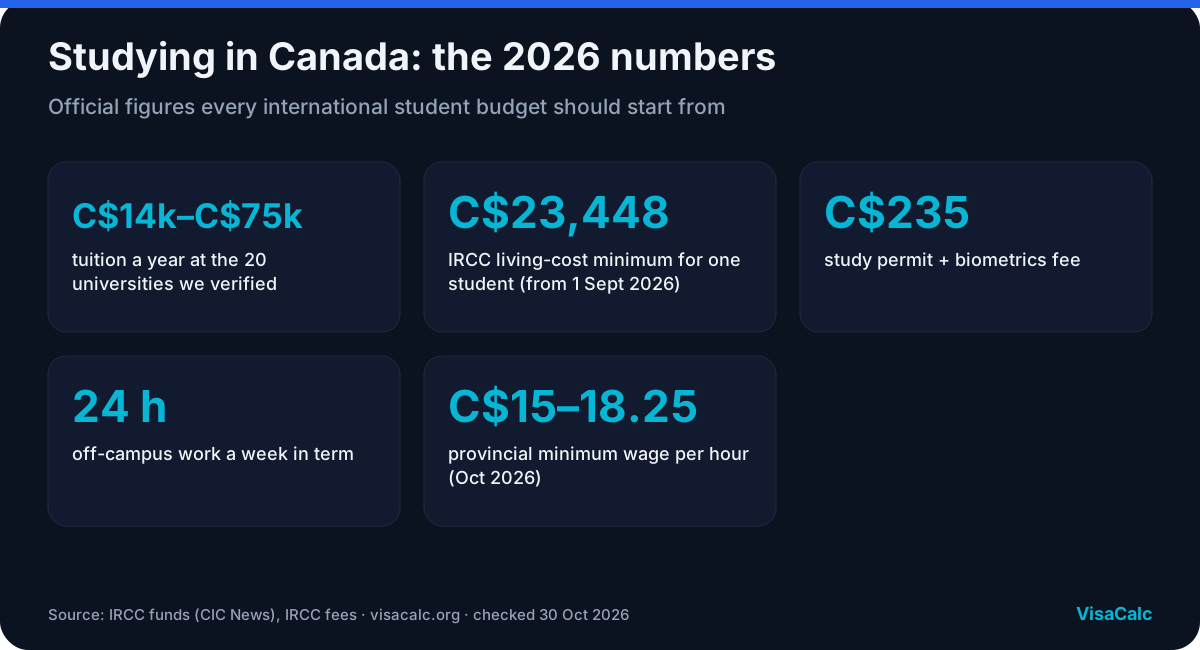
Using tuition plus the official visa living-cost figure for a 4-year bachelor's, with 2026-27 fees held flat and converted at 29 Oct 2026 rates:
| Scenario | Per year | 4-year total |
|---|---|---|
| Lowest fee we verified: University of Manitoba | C$37,847 | C$151,388 ≈ ₹1.03 crore |
| Highest fee we verified: University of Waterloo (most expensive programme) | C$98,448 | C$393,792 ≈ ₹2.68 crore |
The gap of about ₹1.65 crore comes almost entirely from university and programme choice, which is why the programme fee matters more than the headline ranking. Scholarships are not deducted.
5 Proven Strategies to Cut Your Total Cost
1. Choose Tier 2/3 over Tier 1 — saves $80,000-150,000. A computer science degree at a Tier 3 university leads to the same PGWP and PR pathway as one from a Tier 1 school. Employers care about your Canadian work experience far more than your alma mater for most jobs.
2. Target zero-application-fee universities. Several Canadian universities including UBC have dropped application fees entirely for most international programs since 2023. This alone saves $100-200 per application — meaningful when applying to 8-10 schools.
3. Apply for automatic entrance scholarships. Many universities award merit scholarships automatically based on your admission grades — no separate application needed. Scholarships of CAD $5,000-25,000/year are common at both Tier 1 and Tier 3 schools for strong academic records.
4. Choose a co-op program. Co-op students alternate study and paid work terms, often earning CAD $15,000-25,000 per 4-month work term — directly offsetting tuition while building Canadian experience.
5. Work the legal 24 hours/week. At provincial minimum wages of CAD $15.00–18.25/hour (October 2026; Ontario $17.95, BC $18.25), this generates roughly CAD $1,560–1,900/month — covering a meaningful share of living costs, especially in smaller cities.
❓ Frequently Asked Questions — Cost of Studying in Canada
How much does it really cost to study in Canada for 4 years?
Total cost varies dramatically by university tier: Tier 1 universities in major cities cost CAD $260,000-470,000 for a 4-year degree including living expenses. Tier 3 universities in smaller cities can cost as little as CAD $140,000-170,000 for the same 4 years — a difference of over $100,000.
Can working part-time actually cover living expenses in Canada?
Partially. At minimum wage (CAD $15.00 in Alberta to $18.25 in BC; Ontario $17.95 from 1 October 2026) working the legal maximum of 24 hours/week during term generates roughly CAD $1,560–1,900/month before tax — covering 60-80% of living costs in smaller cities, but only 30-40% in Toronto or Vancouver. It significantly reduces but rarely eliminates the need for savings or family support.
What is the single biggest way to reduce study costs in Canada?
Choosing a Tier 2 or Tier 3 university in a smaller city over a Tier 1 university in Toronto or Vancouver. This single decision can reduce your 4-year total cost by CAD $80,000-150,000 through lower tuition, lower rent, and lower general living costs, while still leading to the same PGWP and PR pathway.
Do co-op programs actually save money?
Yes, significantly. Co-op programs alternate study terms with paid work terms, typically earning CAD $15,000-25,000 per 4-month work term. A typical co-op degree includes 2-4 paid work terms, potentially offsetting CAD $30,000-100,000 of total program cost while also building the Canadian work experience valuable for PR applications.
How to cite this page
Chauhan, A. (VisaCalc). "Real Cost of Studying in Canada 2026." VisaCalc. Last modified October 2026. https://visacalc.org/universities/canada-university-costs.html