🇬🇧 Study in the UK: The 2026 Journey, Step by Step
The full 2026 student journey to the UK: a CAS, 28 days of funds, an eVisa and 20 hours of work a week. What visa officers check, what to pack to cut first-month costs, and how much part-time work really covers.
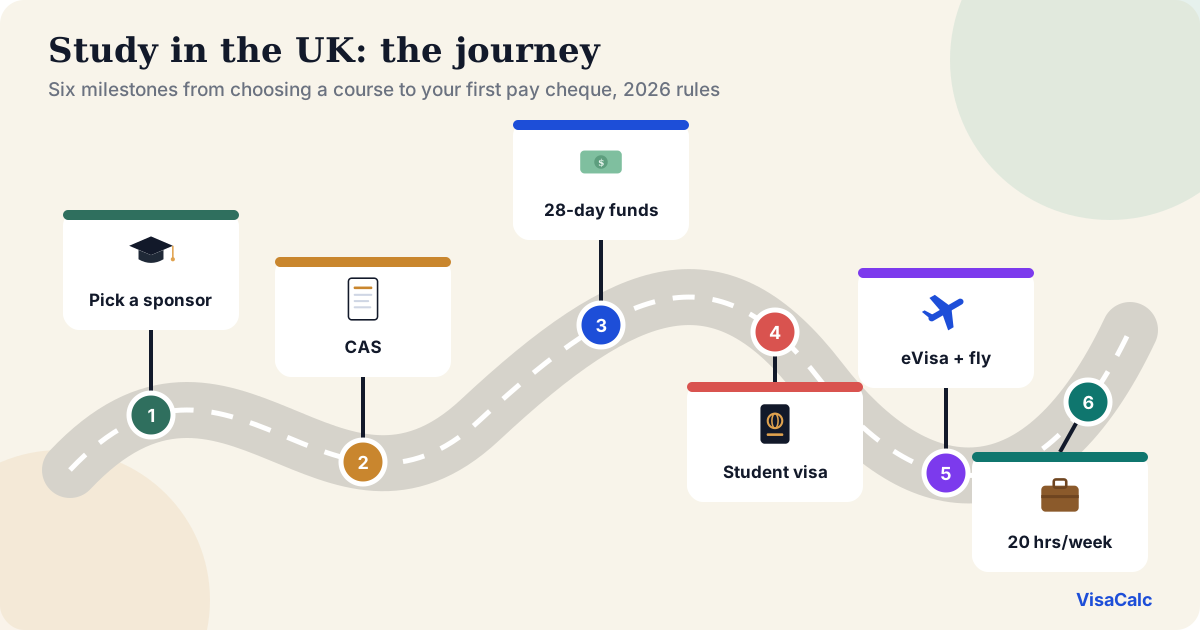
At a glance: the 2026 numbers
| What | UK |
|---|---|
| Document you need from the school | Confirmation of Acceptance for Studies (CAS) |
| Living costs to show | £10,539 outside London or £13,761 in London (9 months × £1,171 or £1,529); £10,827 / £14,130 from 30 November 2026 |
| Work in term | 20 h/week |
| Minimum wage | £12.71 an hour |
| Plugs and voltage | Type G plugs, 230 V |
| Cash to declare | £10,000 or more |
Step 1–9: the journey in order
Timings count back from your course start date. Start earlier if you need a scholarship or an education loan: both add months.
What the visa officer is looking for
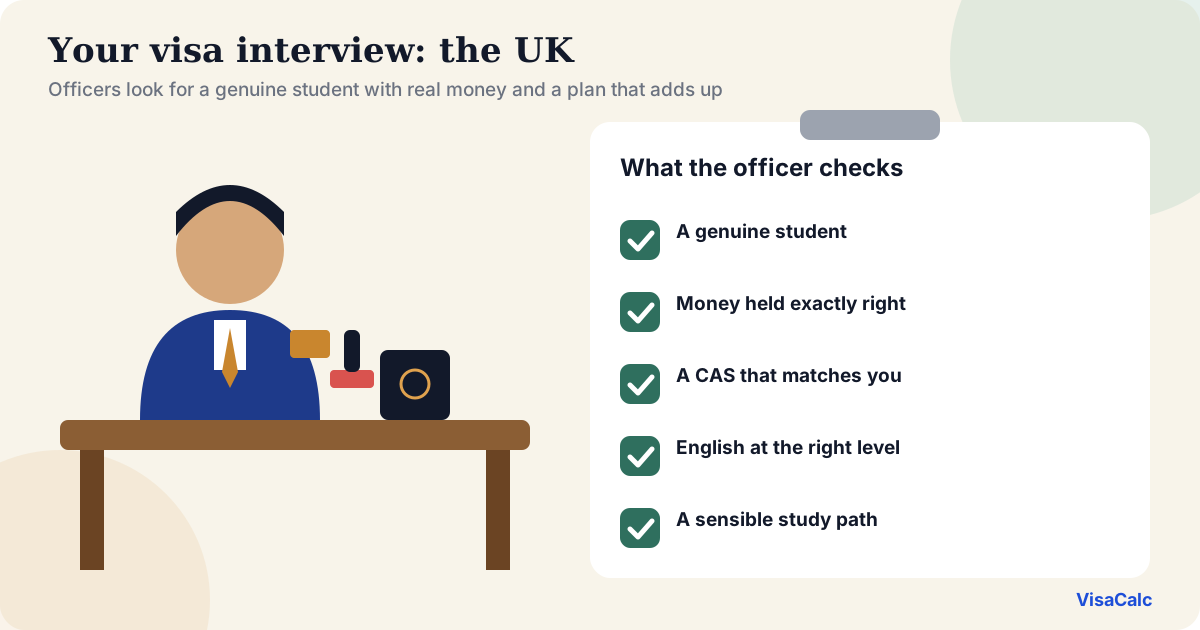
✅ A genuine student
In a credibility interview, staff ask about your course, university, finances and plans. Vague, memorised or agent-written answers are a red flag.
✅ Money held exactly right
Funds must sit in the account for 28 consecutive days ending within 31 days of applying. A single day below the required balance is enough for a refusal.
✅ A CAS that matches you
Names, passport number, course dates and fees on the CAS must match your documents.
✅ English at the right level
The officer can refuse if you cannot hold a basic conversation in English, even with a test score.
✅ A sensible study path
Gaps and changes of subject need a clear explanation.
Before you leave: pack to cut your first-month costs
The first month abroad is the most expensive: deposits, bedding, a phone plan, transport cards and kitchen basics all land at once. Packing the right things from home, and leaving the wrong ones behind, saves real money and trouble at the border. The UK runs on 230 V, like India, so Indian appliances work with a Type G adapter.
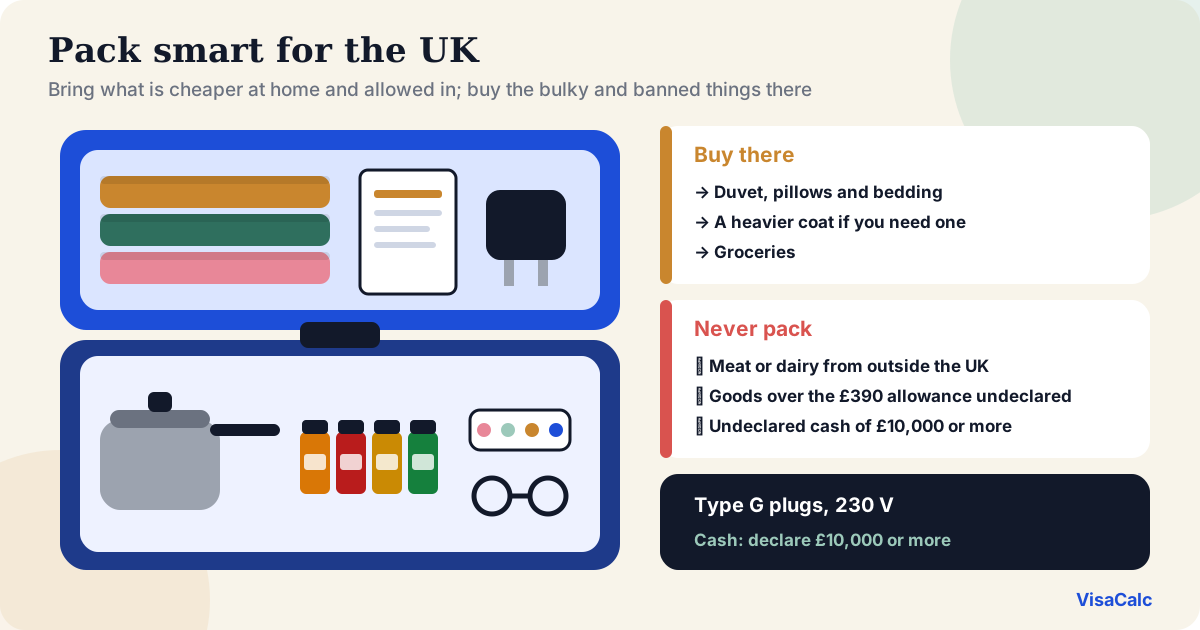
| Item | Why |
|---|---|
| ✅ Bring: A waterproof jacket and warm layers | UK winters are wet more than freezing |
| ✅ Bring: Pressure cooker and one heavy pan | cooking at home saves the most |
| ✅ Bring: Ground, sealed spices | allowed for personal use |
| ✅ Bring: Prescription medicines in original packs | with the prescription |
| ✅ Bring: Spare glasses | opticians are costly |
| ✅ Bring: Type G plug adapters | Indian 230 V appliances then just work |
| ✅ Bring: Passport photos and document copies | for bank and university forms |
| 🛒 Buy there: Duvet, pillows and bedding | cheap from supermarkets in your first week |
| 🛒 Buy there: A heavier coat if you need one | sales run from late autumn |
| 🛒 Buy there: Groceries | Indian groceries are easy to find in most cities |
| ⛔ Never pack: Meat or dairy from outside the UK | banned for personal import, including from the EU since April 2025 |
| ⛔ Never pack: Goods over the £390 allowance undeclared | use the red channel |
| ⛔ Never pack: Undeclared cash of £10,000 or more | seizure and penalties |
💵 Declare cash of £10,000 or more to UK customs when you arrive from outside the UK. Use a forex card or a low-fee multi-currency account for most of your money, and carry only enough cash for the first few days. Full the UK customs rules →
Paying your fees by working, within the rules
| Rule | UK in 2026 |
|---|---|
| During term | Up to 20 hours a week |
| Breaks | Full-time during the vacations your university sets |
| Minimum wage | £12.71 an hour (National Living Wage for workers aged 21 and over from 1 April 2026) |
| Legal maximum in term | £7,626 a year (20 h × 30 weeks) |
Worked example. A realistic plan is fewer hours than the legal maximum, because shifts are not always available and grades matter. Here is what 15 hours a week in term and 35 in breaks earns:
| Item | Amount |
|---|---|
| Term: 15 h/week × 30 weeks × £12.71 | £5,720 |
| Breaks: 35 h/week × 12 weeks × £12.71 | £5,338 |
| Gross earnings a year | £11,058 |
| Tuition (example: a one-year taught master's) | £26,000 |
| Living costs (cost-of-living estimate: £1,171 a month × 12 (Home Office rate outside London)) | £14,052 |
| Share of living costs covered | 79% |
| Share of tuition + living covered | 28% |
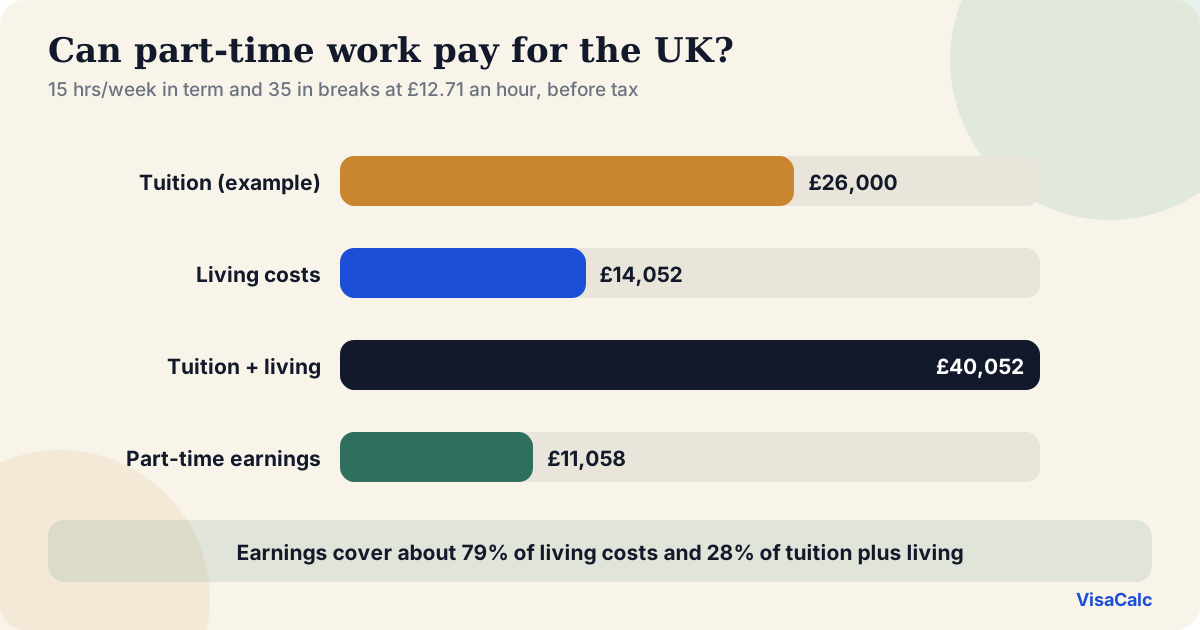
The pattern is the same everywhere: part-time work can cover much of your living costs, but rarely tuition. Plan to pay tuition from savings, a loan or a scholarship, and use wages for rent, food and the second year's buffer. Never go over your hour limit: breaching visa conditions can lead to cancellation and refusals later.
Other ways to bring the bill down
- University scholarships and fee discounts for early deposit payers
- Placement years: full-time work is allowed when the placement is part of the course
- Full-time work in the Christmas, Easter and summer vacations
- Campus jobs: student ambassador, library and events roles
Try your own numbers below. The legal-maximum button fills the most you are allowed to work.
Your first two weeks after landing
| Task | Why it matters |
|---|---|
| Register with a GP | covered by your health surcharge |
| National Insurance number | apply online; needed for tax, not to start work |
| Bank account | many accept your eVisa share code and university letter |
| Railcard or bus pass | a 16–25 or student card cuts fares by a third |
Frequently Asked Questions
What are the steps to study in the UK?
1) Choose a course at a licensed sponsor. 2) Sort out English. 3) Apply. 4) Accept, pay the deposit, get your CAS. 5) Hold the money for 28 days. 6) Apply for the Student visa. 7) Set up your eVisa and travel. 8) GP, bank, National Insurance number. 9) Work up to 20 hours a week.
What do visa officers look for in a UK student visa application?
A genuine student: In a credibility interview, staff ask about your course, university, finances and plans. Vague, memorised or agent-written answers are a red flag. Money held exactly right: Funds must sit in the account for 28 consecutive days ending within 31 days of applying. A single day below the required balance is enough for a refusal. A CAS that matches you: Names, passport number, course dates and fees on the CAS must match your documents.
Can I pay my tuition by working part-time in the UK?
Only partly. Working 15 hours a week in term and 35 in breaks at £12.71 an hour earns about £11,058 a year before tax, roughly 79% of the £14,052 living-cost figure. You must show the first year's funds before the visa is granted, so wages are for later years and living costs, not for getting the visa.
How many hours can international students work in the UK?
Up to 20 hours a week during term. Full-time during the vacations your university sets.
What should I pack to save money when moving to the UK?
Bring: a waterproof jacket and warm layers; pressure cooker and one heavy pan; ground, sealed spices; prescription medicines in original packs; spare glasses. Buy there: duvet, pillows and bedding; a heavier coat if you need one; groceries.
Can I work before my National Insurance number arrives?
Yes. Your employer checks your right to work with your eVisa share code; the National Insurance number is for tax and can follow later.
Sources
Figures on this page were checked against these sources on 31 October 2026. Rules change: confirm on the official site before you apply.