🇮🇹 Study in Italy: The 2026 Journey, Step by Step
The full 2026 student journey to Italy: Universitaly, €10,179.85 in funds, a permesso di soggiorno and 20 hours of work a week. What visa officers check, what to pack to cut first-month costs, and how much part-time work really covers.
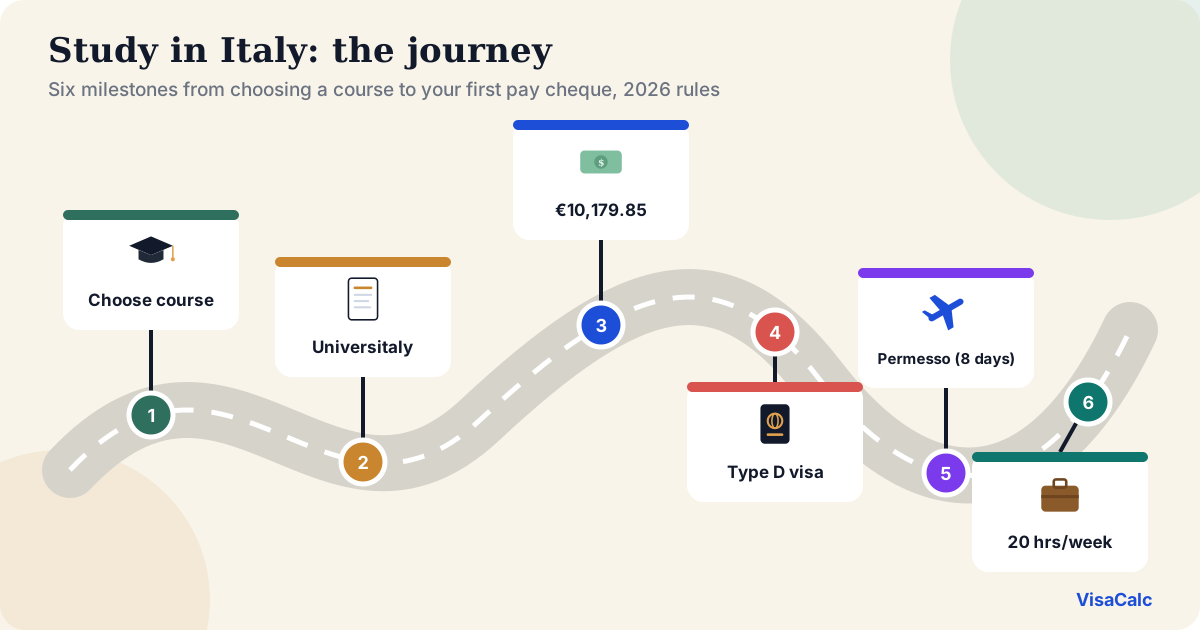
At a glance: the 2026 numbers
| What | Italy |
|---|---|
| Document you need from the school | Universitaly pre-enrolment and admission letter |
| Living costs to show | €10,180 (2026-27 funds requirement of €10,179.85 a year) |
| Work in term | 20 h/week |
| Minimum wage | €9.00 an hour |
| Plugs and voltage | Type F and L plugs, 230 V |
| Cash to declare | €10,000 or more |
Step 1–8: the journey in order
Timings count back from your course start date. Start earlier if you need a scholarship or an education loan: both add months.
What the visa officer is looking for
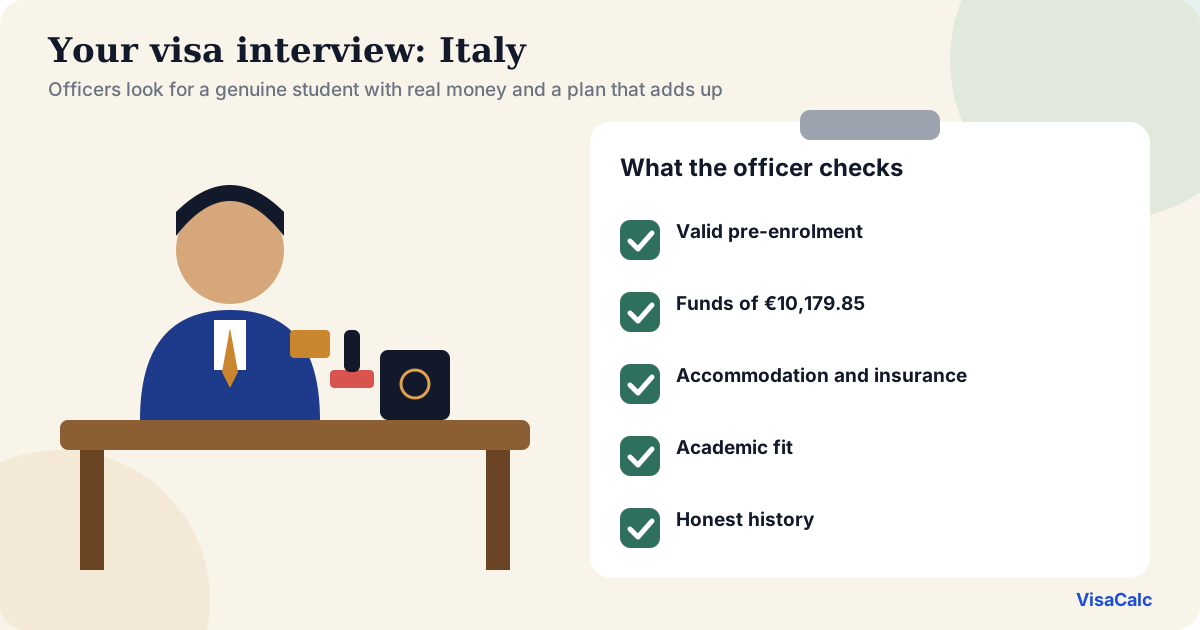
✅ Valid pre-enrolment
A Universitaly summary that matches your admission.
✅ Funds of €10,179.85
Preferably in your own account, or family members' with proof.
✅ Accommodation and insurance
Proof of where you will live and health cover.
✅ Academic fit
A course that follows from your studies.
✅ Honest history
Past refusals disclosed.
Before you leave: pack to cut your first-month costs
The first month abroad is the most expensive: deposits, bedding, a phone plan, transport cards and kitchen basics all land at once. Packing the right things from home, and leaving the wrong ones behind, saves real money and trouble at the border. Italy runs on 230 V, so Indian appliances work with a Type F/L adapter.
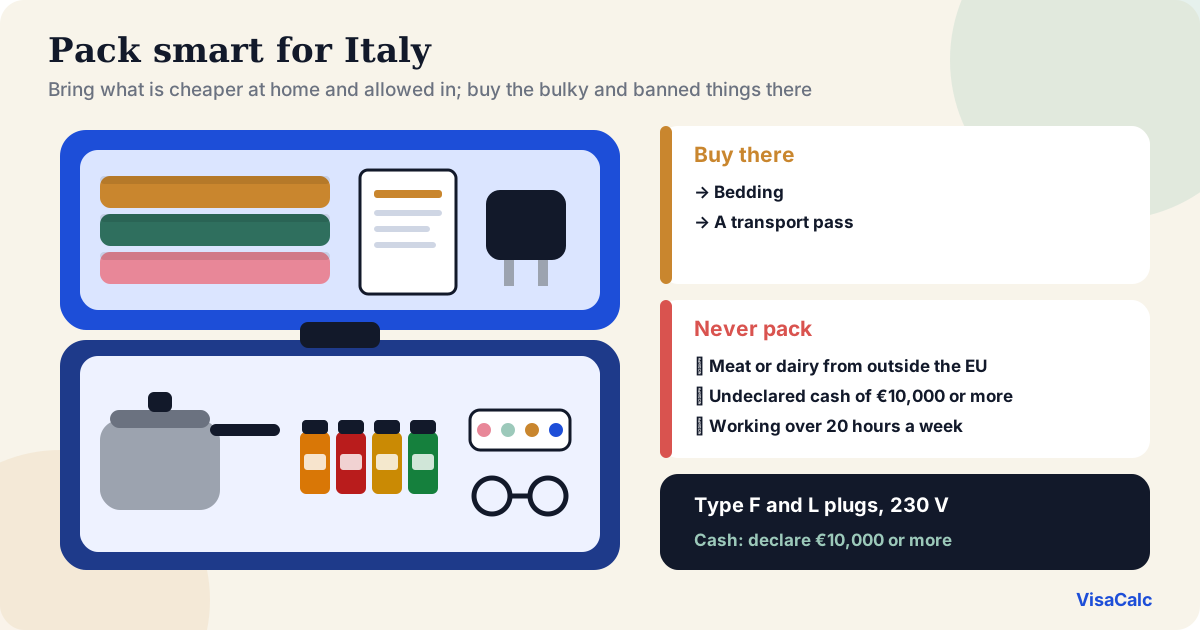
| Item | Why |
|---|---|
| ✅ Bring: Layers for hot summers and cold winters | north Italy is cold in winter |
| ✅ Bring: Pressure cooker and one heavy pan | cooking at home saves the most |
| ✅ Bring: Ground, sealed spices | allowed for personal use |
| ✅ Bring: Prescription medicines in original packs | with the prescription |
| ✅ Bring: Type F/L plug adapters | Indian 230 V appliances then work |
| ✅ Bring: Passport photos and document copies | for the permesso kit |
| 🛒 Buy there: Bedding | local markets are cheap |
| 🛒 Buy there: A transport pass | student passes are discounted |
| ⛔ Never pack: Meat or dairy from outside the EU | banned for personal import into the EU |
| ⛔ Never pack: Undeclared cash of €10,000 or more | seizure and fines |
| ⛔ Never pack: Working over 20 hours a week | even in breaks |
💵 Declare cash of €10,000 or more when you enter the EU. Use a forex card or a low-fee multi-currency account for most of your money, and carry only enough cash for the first few days. Full Italy customs rules →
Paying your fees by working, within the rules
| Rule | Italy in 2026 |
|---|---|
| During term | Up to 20 hours a week |
| Breaks | Still 20 hours a week in breaks (1,040 hours a year at most) |
| Minimum wage | €9.00 an hour (example; Italy has no statutory minimum wage, pay follows sector agreements) |
| Legal maximum in term | €5,400 a year (20 h × 30 weeks) |
Worked example. A realistic plan is fewer hours than the legal maximum, because shifts are not always available and grades matter. Here is what 15 hours a week in term and 20 in breaks earns:
| Item | Amount |
|---|---|
| Term: 15 h/week × 30 weeks × €9.00 | €4,050 |
| Breaks: 20 h/week × 12 weeks × €9.00 | €2,160 |
| Gross earnings a year | €6,210 |
| Tuition (example: a public university fee for international students) | €3,000 |
| Living costs (2026-27 funds requirement of €10,179.85 a year) | €10,180 |
| Share of living costs covered | 61% |
| Share of tuition + living covered | 47% |
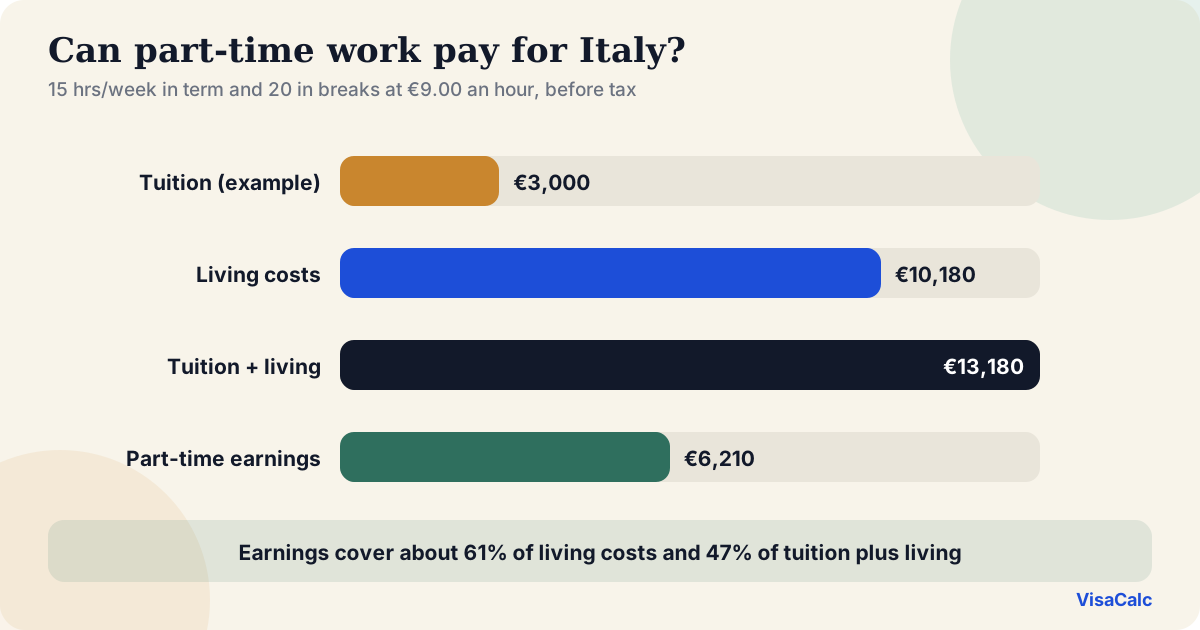
The pattern is the same everywhere: part-time work can cover much of your living costs, but rarely tuition. Plan to pay tuition from savings, a loan or a scholarship, and use wages for rent, food and the second year's buffer. Never go over your hour limit: breaching visa conditions can lead to cancellation and refusals later.
Other ways to bring the bill down
- Regional DSU scholarships based on family income, which can include free housing and meals
- University fee reductions
- "150 ore" paid part-time jobs at the university
- A 12-month job-seeker permit after graduating
Try your own numbers below. The legal-maximum button fills the most you are allowed to work.
Your first two weeks after landing
| Task | Why it matters |
|---|---|
| Permesso di soggiorno kit | within 8 working days |
| Codice fiscale | tax code for everything |
| Health cover | national health service enrolment or private |
| Bank account | for rent and wages |
Frequently Asked Questions
What are the steps to study in Italy?
1) Choose a course. 2) Language tests and documents. 3) Apply and pre-enrol on Universitaly. 4) Show the funds. 5) Apply for the type D study visa. 6) Apply for the permesso di soggiorno. 7) Codice fiscale, health, bank. 8) Work up to 20 hours a week.
What do visa officers look for in a Italy student visa application?
Valid pre-enrolment: A Universitaly summary that matches your admission. Funds of €10,179.85: Preferably in your own account, or family members' with proof. Accommodation and insurance: Proof of where you will live and health cover.
Can I pay my tuition by working part-time in Italy?
Only partly. Working 15 hours a week in term and 20 in breaks at €9.00 an hour earns about €6,210 a year before tax, roughly 61% of the €10,180 living-cost figure. You must show the first year's funds before the visa is granted, so wages are for later years and living costs, not for getting the visa.
How many hours can international students work in Italy?
Up to 20 hours a week during term. Still 20 hours a week in breaks (1,040 hours a year at most).
What should I pack to save money when moving to Italy?
Bring: layers for hot summers and cold winters; pressure cooker and one heavy pan; ground, sealed spices; prescription medicines in original packs; type F/L plug adapters. Buy there: bedding; a transport pass.
Can I work full-time in Italy during summer as a student?
No. A study permit allows up to 20 hours a week all year, including breaks, and 1,040 hours a year. To work more you must convert to a work permit.
Sources
Figures on this page were checked against these sources on 31 October 2026. Rules change: confirm on the official site before you apply.