🔧 Immigration for Skilled Trades 2026
Electricians, plumbers, welders and other skilled tradespeople are among the most in-demand workers for immigration — and often overlooked by applicants who focus only on degree-based routes.

🇨🇦 Canada — Federal Skilled Trades Program (FSTP) and Trades Category
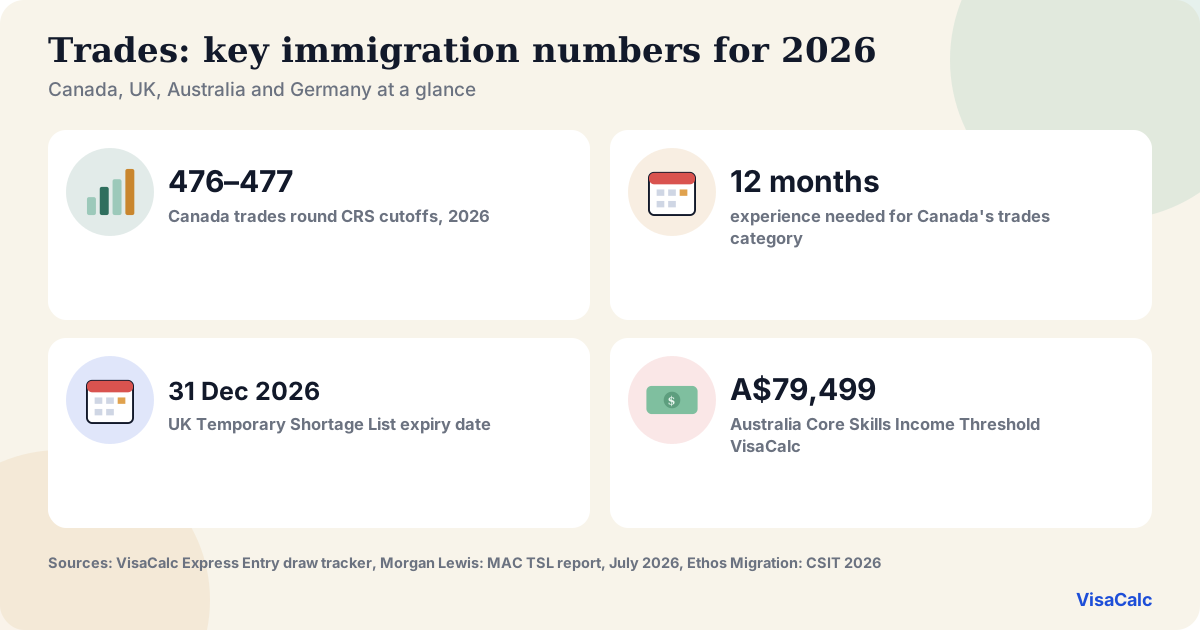
The FSTP is a dedicated Express Entry stream for qualified tradespeople with no minimum education requirement — just 2 years of full-time work experience in a qualifying trade within the last 5 years, plus language and (for most trades) a certificate of qualification or valid job offer. Separately, the Express Entry Trades category (one of the category-based draws introduced under the Feb 2026 restructuring) requires only 12 months of relevant experience and cut off at 476–477 in its 2026 rounds, below the 507–523 needed in 2026 Canadian Experience Class rounds, making it one of the strongest pathways for any profession on this site.
Qualifying Trade Categories for Canada
| Trade | NOC Code | Demand Level |
|---|---|---|
| Electricians | 72200–72203 | Very High |
| Plumbers | 72300 | Very High |
| Welders | 72106 | High |
| Carpenters | 72310 | High |
| Heavy Equipment Operators | 73400 | High |
| Construction Managers | 70010 | Moderate |
Note: as of the Feb 2026 Express Entry restructuring, cooks/chefs were removed from the Trades category — the table above reflects trades that remain eligible.
🇬🇧 UK — Route Depends on the Temporary Shortage List, Not a Standing "Shortage Occupation List"
The UK's Skilled Worker skill threshold rose to RQF Level 6 in July 2025, meaning most trades (typically RQF Level 3-5) lost automatic eligibility for the standard route. Electricians, plumbers, and HVAC engineers can currently only be sponsored via the Temporary Shortage List (TSL), which is now operational and covers select trade and technical roles — but salary thresholds vary by specific occupation code, not a single flat figure: electricians (SOC 5241) need £38,800 (standard rate) or £31,500 (lower rate, for those on Skilled Worker status before 4 April 2024), plumbers (SOC 5315) need £38,100/£31,400, and building/civil engineering technicians (SOC 3114) need £33,400/£27,900. Always check the exact SOC code for your specific role on the official gov.uk Temporary Shortage List rather than assuming a single threshold applies across all trades. The current Temporary Shortage List expires on 31 December 2026. On 23 July 2026 the Migration Advisory Committee recommended cutting it from 52 to 28 occupations, with 18 months of access each; the government had not said which recommendations it will accept when we checked on 30 October 2026 (Morgan Lewis summary). A significant restriction worth knowing: applicants sponsored on TSL roles at RQF Level 3-5 cannot bring dependants (partner or children) to the UK, unlike standard RQF6+ Skilled Worker applications.
🇦🇺 Australia — 190/491 State Nomination Priority, MLTSSL-Listed
Skilled tradespeople are priority occupations in most Australian states and sit on the MLTSSL (Medium and Long-Term Strategic Skills List). State nomination (190) adds 5 points; regional nomination (491) adds 15 points — both put well-qualified tradespeople above the invitation threshold for their occupation. A skills assessment through TRA (Trades Recognition Australia) or the relevant assessing authority is required before applying. Trade occupations account for roughly half of Australia's persistent labour shortages, particularly amid the ongoing housing construction push.
Certification & Recognition Timelines
| Country | Certification Body | Typical Timeline |
|---|---|---|
| Canada | Red Seal interprovincial certification (provincial licensing) | 3-9 months |
| UK | Relevant competent-person scheme registration (e.g. NICEIC for electricians) | 3-6 months, subject to TSL eligibility |
| Australia | TRA (Trades Recognition Australia) skills assessment | 4-8 months |
Common Mistakes
- Assuming the UK's old "Shortage Occupation List" still exists in its previous form. The skill threshold change in July 2025 replaced automatic trade eligibility with dependence on the time-limited Temporary Shortage List instead.
- Not obtaining Red Seal certification before assuming Canadian employment is guaranteed. Immigration eligibility and the ability to legally practice a trade in Canada are separate requirements — budget time for both.
- Overlooking the Express Entry Trades category's much lower CRS cutoffs. Many qualified tradespeople default to general draws without realizing the Trades category clears at a fraction of the score needed elsewhere.
- Assuming cooks/chefs are still covered under "skilled trades" for Canada. They were explicitly removed from the Trades category in the February 2026 restructuring.
Frequently Asked Questions
What's the fastest immigration route for a tradesperson?
Canada's Express Entry Trades category, whose 2026 rounds cut off at 476–477 with 12 months of experience — significantly more accessible than general skilled-worker routes for most tradespeople.
Is the UK still a good option for tradespeople?
It's a narrower route than before. Since July 2025, most trades no longer qualify under the UK's standard Skilled Worker route and depend instead on the Temporary Shortage List (now operational, with salary thresholds that vary by specific occupation code — e.g. £38,800 for electricians, £38,100 for plumbers — not a single flat figure), which runs only until 31 December 2026 pending a policy review. TSL applicants at RQF3-5 also can't bring dependants, unlike the standard route.
Do I need Red Seal certification to immigrate to Canada as a tradesperson?
Not always required for the immigration application itself, but it's the recognized standard for legally practicing most trades across Canada — budget time for this alongside your immigration application, since it's a separate process.
Which trades are in highest demand in Australia?
Electricians, plumbers, and construction-related trades consistently rank among Australia's highest-demand occupations, driven by the ongoing housing construction push across most states and territories.
Methodology
Figures compiled from IRCC (Canada), UK Home Office/Migration Advisory Committee guidance, and Australian Department of Home Affairs occupation lists, cross-checked in 2026. CRS cutoffs reflect recent draw history and can shift with each draw. UK trade eligibility is subject to an active policy review and may change before the TSL's current end date.
Limitations
- This page covers general trade categories — specific occupation eligibility varies by exact job duties, not job title alone.
- UK trade sponsorship eligibility is time-limited and under active review; verify current status before relying on it.
- This page does not constitute immigration advice.
Frequently Asked Questions
What CRS do trades need in Canada in 2026?
The 2026 trades rounds cut off at 476–477, about 30–45 points below Canadian Experience Class rounds.
Can UK employers still sponsor tradespeople?
Only through the Temporary Shortage List, which expires on 31 December 2026. The Migration Advisory Committee proposed a shorter list of 28 occupations in July 2026; the government had not decided by 30 October 2026.
Sources
Figures on this page were checked against these official or primary sources on 30 October 2026.