🇵🇭 Immigration from Philippines 2026
Filipino applicants, especially nurses and healthcare workers, have some of the best-established immigration pathways in the world. Here's the complete guide.

Worked example: a Filipino nurse in Express Entry
| Factor | CRS |
|---|---|
| Age 32 | 94 |
| Bachelor's in nursing | 120 |
| English CLB 9 | 124 |
| Transferability (education and foreign experience with CLB 9) | 75 |
| Total | 413 |
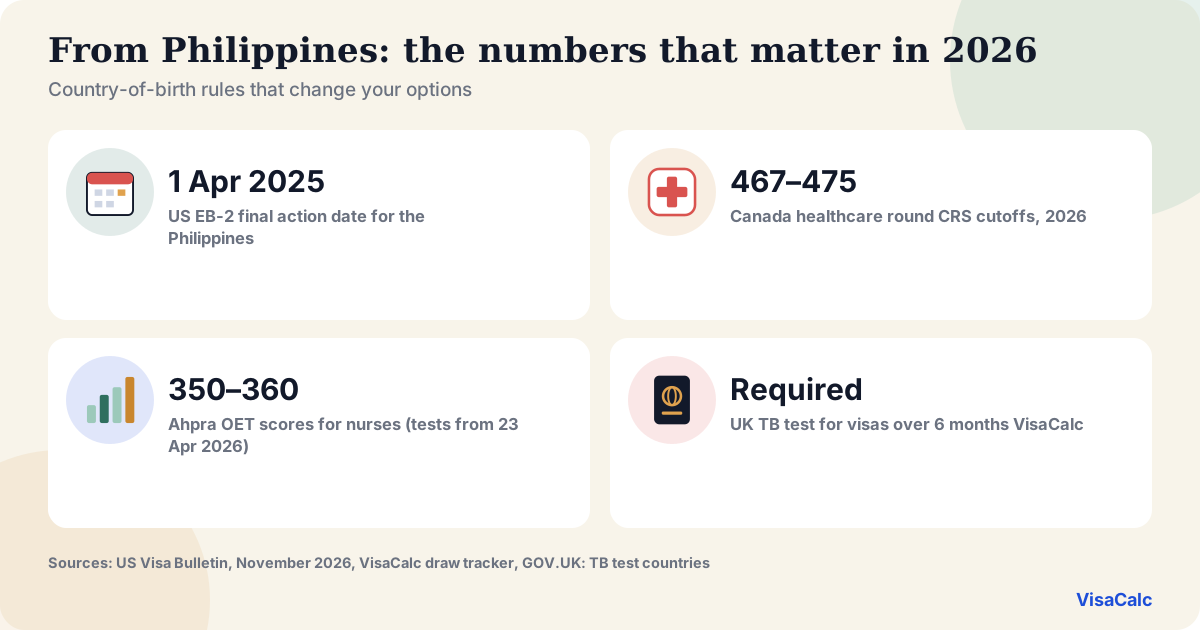
| With French at NCLC 7 | 475, at the top of the 2026 healthcare cutoffs (467–475) |
The Filipino Advantage
Filipino applicants have several natural advantages: English is an official language (no IELTS preparation needed for most applications), strong nursing tradition (Philippines is the world's largest exporter of nurses), and established diaspora in Canada, Australia and UK creating community support.
🇨🇦 Canada — Best Pathway for Filipino Nurses
The Philippines → Canada pathway for nurses is one of the most well-established immigration routes in the world. NNAS assessment + provincial registration + Healthcare Express Entry draw = PR in 2–4 years. Canadian Filipino community (800,000+) provides strong settlement support.
🇦🇺 Australia — Strong Healthcare Demand
Australia actively recruits Filipino nurses through the ANMAC assessment process. AHPRA's English requirement is genuinely specific: IELTS Academic 7.0 overall and in listening, reading and speaking, with 6.5 in writing, for tests taken from 23 April 2026 (or OET, which changed in April 2026 to precise numerical minimums — Reading and Speaking now need 360, higher than Listening/Writing's 350). Registered nurses are on Australia's skilled occupation lists, and many states nominate nurses for the Subclass 190 or 491, which add 5 or 15 points to the 65-point minimum.
🇬🇧 UK — NHS International Recruitment
The NHS actively runs international recruitment campaigns targeting Filipino nurses. The NMC registration pathway (CBT + OSCE) is well-documented for Filipino applicants — note NMC's IELTS requirement is 7.0 in Listening, Reading and Speaking but only 6.5 in Writing, a genuinely more achievable bar on that skill specifically. The current path to ILR is 5 years, but on 2 November 2026 the government confirmed a 10-year baseline under "Earned Settlement" (5 years above £50,270, with protection for some care and health workers who arrived before May 2025); rules start from December 2026, so the 5-year route applies until then.
For Filipino Students
Filipino students applying to Canada, UK or Australia benefit from English proficiency — many universities accept Filipino education without IELTS in some circumstances. IELTS is still recommended for the highest score advantage in Canada CRS calculation.
The OFW Factor
A significant share of Filipino immigration applicants are already Overseas Filipino Workers (OFWs) rather than Philippines-based applicants — OFW remittances have historically made up roughly 8-9% of Philippine GDP, among the highest ratios of any country in the world. Work experience gained abroad (in the Gulf, Hong Kong, Singapore, or elsewhere) generally counts the same as Philippines-based experience for points-based immigration systems, provided it's properly documented with reference letters and payslips.
Common Mistakes
- Assuming English proficiency exemptions apply automatically. Some universities and employers waive formal English testing for Filipino applicants, but this varies by institution — always confirm before assuming you can skip IELTS.
- Underestimating NNAS/NMC/AHPRA credential timelines. Even with strong English skills and nursing experience, credential recognition still takes months — start the process before you have a confirmed job offer.
- Not documenting overseas (OFW) work experience properly. Reference letters and payslips from Gulf or Asian employers need to meet the same documentation standards as domestic experience for points-based systems to count it.
- Overlooking that IELTS still matters for CRS score optimization. Even where English exemptions exist for admission purposes, a strong IELTS score still adds meaningful CRS points in Canada's Express Entry system.
Frequently Asked Questions
Do Filipino applicants need IELTS?
Some universities and employers waive formal testing given English is an official language in the Philippines, but this varies — and IELTS is still recommended for the highest score advantage in Canada's CRS calculation specifically.
Does OFW (overseas) work experience count for immigration points?
Generally yes, provided it's properly documented with reference letters and payslips — many Filipino applicants build their immigration profile around Gulf or Asia-based OFW experience rather than Philippines-based roles.
How long does the Canada nursing pathway take from the Philippines?
Typically 2-4 years from starting the NNAS assessment through to permanent residence, combining credential recognition, provincial registration, and Healthcare category Express Entry draws.
Methodology
Figures compiled from IRCC (Canada), Australian ANMAC/AHPRA, UK NMC/Home Office, and Philippine Statistics Authority/Bangko Sentral remittance data, cross-checked in 2026.
Limitations
- English testing exemptions vary by specific institution or employer — always confirm requirements directly.
- Credential recognition timelines vary by individual case complexity and current processing backlogs.
- This page does not constitute immigration advice.
Frequently Asked Questions
Is nursing the fastest route from the Philippines?
Usually. Canada's 2026 healthcare rounds cut off at 467–475, and nurses are in demand in Australia and the UK, each with its own registration and English test rules.
Sources
Figures on this page were checked against these official or primary sources on 30 October 2026.