🇵🇹 Portugal Visas 2026 — D7, D8 Digital Nomad & EU Residency Guide
Portugal has become one of the most popular immigration destinations for Indians, Brazilians and remote workers. Three key routes: D7 Passive Income, D8 Digital Nomad, and the Portugal path to EU citizenship.

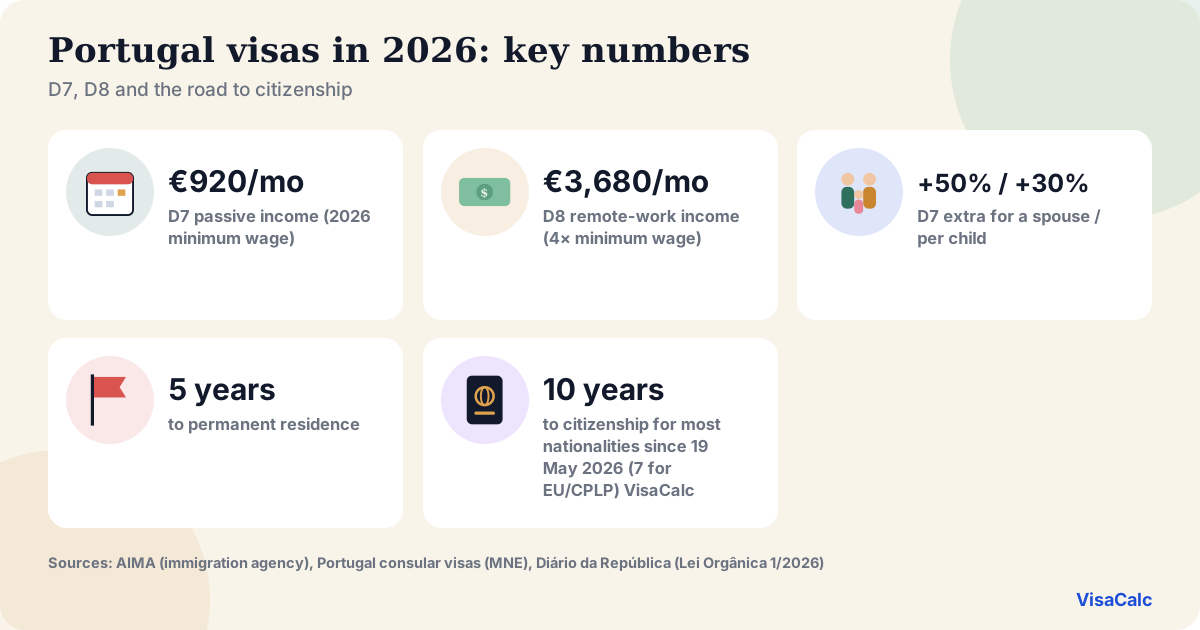
Worked example: D7 income for a family of three
Income must come from passive sources such as pensions, rent or dividends. Consulates also expect proof of accommodation in Portugal, and many ask to see the funds in a Portuguese bank account.
| Person | Monthly | Yearly |
|---|---|---|
| Main applicant | €920 | €11,040 |
| Spouse (+50%) | €460 | €5,520 |
| One child (+30%) | €276 | €3,312 |
| Total passive income needed | €1,656 | €19,872 |
⚠️ Major Change: Citizenship Timeline Extended, 19 May 2026
Portugal's Nationality Law reform (Lei Orgânica n.º 1/2026) took effect 19 May 2026, extending the residency-to-citizenship wait from 5 years to 10 years for most nationalities, including India (7 years for EU and Portuguese-speaking/CPLP country nationals). The clock now starts from when your first residence permit is issued, not your application date. Applications formally submitted to the IRN on or before 18 May 2026 are still assessed under the old 5-year rule — but any new applicant starting residency today faces the longer timeline. Portugal residency itself (and its practical benefits — living, working, and travelling within Portugal and the wider Schengen area) is unaffected; only the wait for full citizenship changed.
The 3 Most Popular Portugal Visa Routes
1. 🏠 D7 Passive Income Visa — "The Retiree / Remote Earner Visa"
Minimum income: €920/month (€11,040/year, equal to Portugal's 2026 minimum wage) from passive sources — pension, rental income, dividends, savings interest. Also accepted: remote employment income if the employer is outside Portugal.
| Requirement | Details |
|---|---|
| Minimum Income | €920/month (+ 50% for a spouse, €460; + 30% per child, €276) |
| Tax Regime | NHR closed to new applicants on 31 March 2025, replaced by the much narrower IFICI (20% flat rate, tech/science/strategic sectors only). Most D7 retirees don't qualify — foreign pensions are now taxed at standard progressive rates (14.5%-53%), not the old 10% flat rate. |
| Residence Required | Minimum 183 days/year in Portugal |
| PR Timeline | 5 years → PR; citizenship now requires 10 years total residency for most nationalities (7 for EU/CPLP), following the May 2026 reform |
Important 2026 update: the D7's old tax appeal (a flat 10% rate on foreign pensions/passive income under NHR) no longer applies to new applicants. If your main goal was tax optimization rather than lifestyle, verify current IFICI eligibility criteria before assuming the visa still delivers the same tax benefit it did before March 2025.
2. 💻 D8 Digital Nomad Visa — "The Remote Worker Visa"
Launched in 2022 and very popular with Indian IT professionals and freelancers. Work remotely for clients/employers outside Portugal while living there.
| Requirement | Details |
|---|---|
| Minimum Income | €3,680/month (4× Portugal's 2026 minimum wage of €920 — this threshold rises each year with the minimum wage) |
| Work Type | Remote employment or freelance — employer/clients outside Portugal |
| Tax | NHR closed to new applicants (31 March 2025). IFICI now offers a 20% flat rate, but only on Portuguese-source income from qualifying tech/science/strategic-sector activities — non-qualifying nomads fall back to standard progressive rates (14.5%-53%). |
| Availability | Short-stay (1yr) or long-stay (2yr) versions available |
3. 🎓 Student → Work → Residency Pathway
Study at a Portuguese university (many programs in English), graduate, find a job in Portugal or the EU. Citizenship now requires 10 years of legal residency for most nationalities (7 for EU/CPLP), following the May 2026 reform. Cost of living in Portugal is significantly lower than UK, Germany or Australia.
Why Indians Choose Portugal
- 🇪🇺 EU passport pathway — now 10 years of residency for most nationalities (7 for EU/CPLP) since the May 2026 reform, leading to the right to live and work across 27 EU countries
- 💰 IFICI tax regime (NHR's narrower 2026 replacement) — 20% flat tax for qualifying tech/science professionals only, not a general benefit
- 🌡️ Climate — warm, Mediterranean
- 🏠 Cost of living — lower than UK, France, Germany
- ✈️ Schengen access — travel freely across Europe
- 🇧🇷 Portuguese language — 280M+ speakers, growing global importance
Portugal vs UK vs Canada — Comparison for Indians
| Factor | 🇵🇹 Portugal | 🇬🇧 UK | 🇨🇦 Canada |
|---|---|---|---|
| PR Timeline | 5 years | 5 years (ILR) | 6–18 months |
| Citizenship | 10 years for most nationalities, 7 for EU/CPLP (since May 2026) | 6 years | 3–5 years |
| EU Access | ✅ Yes — 27 countries | ❌ Post-Brexit | ❌ No |
| Salary levels | Lower than UK/CA | High | High |
| Job market (English) | Limited — Portuguese helps | Large | Large |
| Digital Nomad visa | ✅ D8 — easy | ❌ None | ❌ None |
Frequently Asked Questions
How long does it take to get Portuguese citizenship now?
For applications from 19 May 2026, 10 years of legal residence for most nationalities and 7 years for EU and Portuguese-speaking (CPLP) nationals. Applications submitted on or before 18 May 2026 are assessed under the old 5-year rule.
How much income do I need for the Portugal D8 digital nomad visa?
€3,680 a month in 2026, four times the national minimum wage of €920. The threshold rises each year with the minimum wage.
Is the NHR tax regime still available?
No. NHR closed to new applicants on 31 March 2025. Its replacement, IFICI, gives a 20% flat rate only to qualifying tech, science and strategic-sector roles.
Sources
Figures on this page were checked against these official or primary sources on 30 October 2026.