What is CRS? Canada's Comprehensive Ranking System Explained

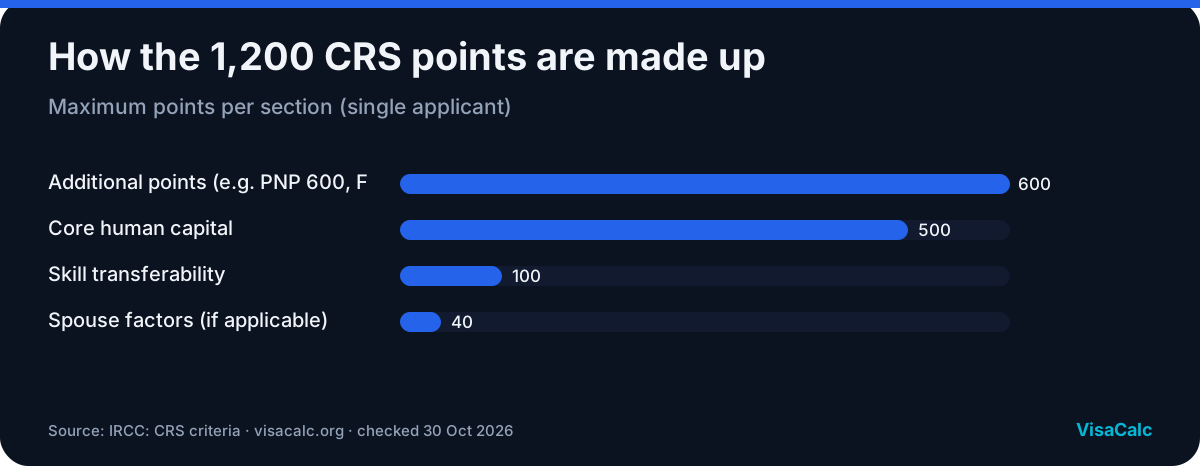
CRS stands for Comprehensive Ranking System — the points-based scoring formula IRCC uses to rank every candidate in the Express Entry pool. Your CRS score, out of a maximum 1,200 points, determines whether and when you receive an Invitation to Apply (ITA) for Canadian permanent residence.
How CRS Points Are Calculated
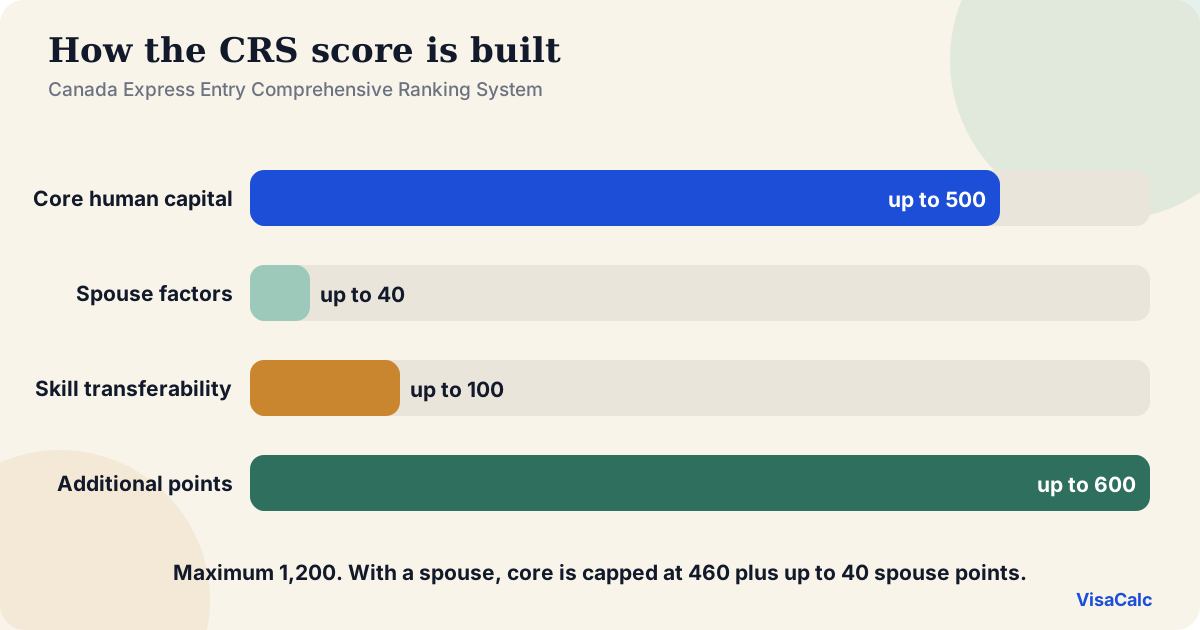
| Category | Max Points (no spouse) | Max Points (with spouse) |
|---|---|---|
| Core: Age, Education, Language | 420 | 390 |
| Labour Market Integration (from 3 Nov 2026): Canadian work experience + high-wage bonus, or a high-wage job offer | 150 | 140 |
| Spouse factors | — | 40 |
| Skill transferability | 100 | 100 |
| Additional points (PNP, Canadian education, sibling, French) | 600 | 600 |
| Maximum total | 1,200 | 1,200 |
From 3 November 2026 Canadian work experience moved out of the core factors into the new Labour Market Integration factor, alongside job offer points for high-wage occupations. IRCC has not yet published a revised overall maximum, so we show the long-standing 1,200 total.
A Provincial Nominee Program (PNP) nomination is worth 600 points on its own — more than the maximum core score — which is why it's the single biggest lever most candidates have to improve their ranking.
Worked example: A candidate with a core CRS score of 460 (below most general draw cutoffs) receives a PNP nomination worth 600 points. New total: 460 + 600 = 1,060 — instantly placing them above every general and category-based cutoff seen in 2026, since 2026 PNP-specific rounds cut off at 697–805 rather than competing with the general pool at all. This single mechanic is why many candidates with otherwise middling core scores actively pursue provincial nomination as their primary strategy rather than waiting to improve language or education scores.
Skill transferability (up to 100 points) is the category most candidates understand least: it rewards combinations, like strong language scores paired with Canadian work experience, or a foreign credential paired with strong language ability, rather than any single factor alone. A candidate with excellent language scores but no matching education or experience combination can miss out on the full 100 points despite a strong language result on its own.
How CRS Cutoffs Work
IRCC doesn't have a fixed "passing score." Instead, they invite the highest-ranked candidates in the pool at regular draws, and the CRS score of the lowest-ranked candidate invited becomes that draw's "cutoff." Cutoffs move up and down depending on how many high-scoring candidates are in the pool at the time and how many invitations IRCC issues that round. Important 2026 context: IRCC has not held a "General — All Programs" draw since 2024 — all 2026 invitations have come through program-specific rounds (Canadian Experience Class, cutoffs 507–523; Provincial Nominee Program, 697–805) or category rounds (French 382–435, healthcare 467–475, trades 476–477, transport 470–477, senior managers 389–429, physicians 169–223). There were no STEM or education rounds in 2026. Don't plan your strategy around general-draw cutoffs from older guides; check the current draw tracker for what's actually being invited right now.
Common Mistakes
- Calculating CRS manually and getting it wrong. The formula has several interacting caps and bonus combinations that are easy to miscalculate by hand.
- Letting language test results lapse. IELTS/CELPIP results are valid for 2 years — an expired test silently zeroes out your language points.
- Assuming any job offer adds CRS points. From 3 November 2026 an offer earns 50, 70 or 100 points only in a high-wage occupation, and it replaces rather than adds to your Canadian work experience points. Other offers earn nothing, though any offer can unlock PNP streams.
Frequently Asked Questions
What is a good CRS score in 2026?
There's no single "good" score because IRCC hasn't run a "General — All Programs" draw since 2024. In 2026 (to 28 October) Canadian Experience Class rounds needed 507–523, Provincial Nominee Program rounds 697–805 (a nomination adds 600 points), and category rounds ranged from 169–223 for physicians and 382–435 for French to 467–477 for healthcare, trades and transport. There were no STEM rounds, so build a parallel plan (French, a provincial nomination, Canadian experience or an eligible category) and check the current draw tracker rather than older guides.
How do I check my own CRS score?
Use our free CRS Score Calculator, which walks through every scoring category and gives you an instant total.
Can my CRS score change after I enter the pool?
Yes — updating your profile with a new job offer, improved language test result, additional education, or a PNP nomination all recalculate your score immediately.
Sources
Figures on this page were checked against these official or primary sources on 30 October 2026.