UK ILR "Earned Settlement" Changes 2026 — What's Actually Confirmed vs Proposed

Worked example
| Scenario | Outcome |
|---|---|
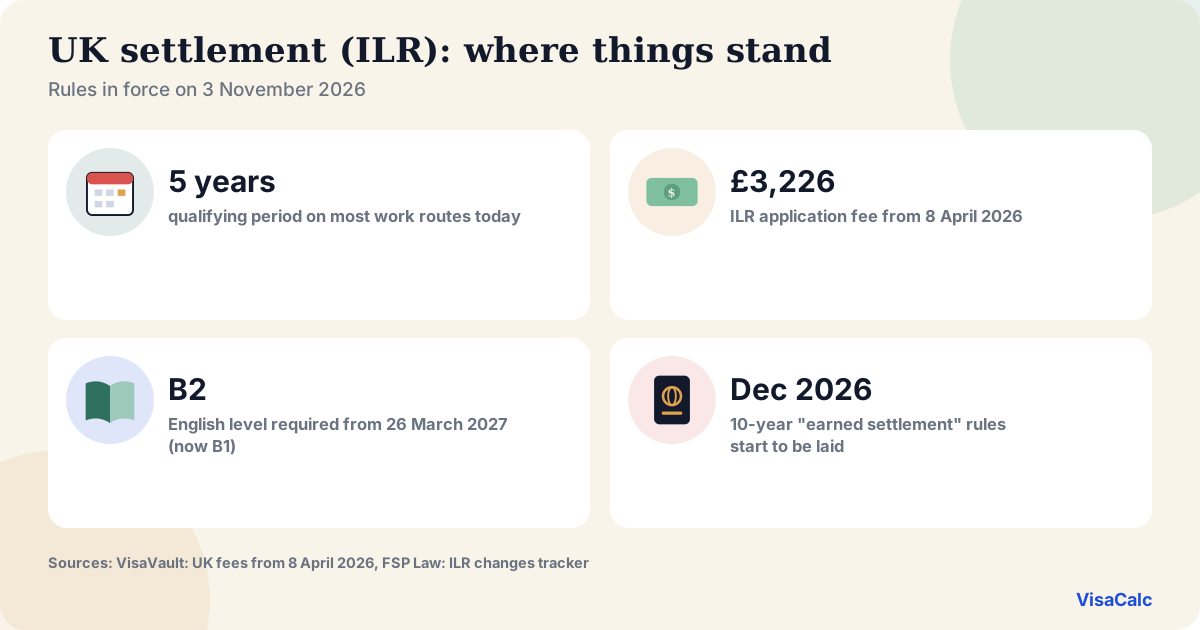
| A Skilled Worker who arrived in March 2022 reaches 5 years in March 2027. | They can apply under the 5-year rule if it is still in force, but from 26 March 2027 they need B2 English instead of B1, so applying a few days early or passing B2 in advance matters. |
TL;DR: On 2 November 2026 the UK government confirmed "Earned Settlement": the standard ILR qualifying period will rise from 5 to 10 years, with 5 years for earnings above £50,270 and 3 years above £125,140. It is policy, not yet law: rules start to be laid from December 2026 and take effect during 2027. Already law: B2 English for settlement from 26 March 2027.
What was confirmed on 2 November 2026
The Home Office published its response to the consultation A Fairer Pathway to Settlement, which ran from 20 November 2025 to 12 February 2026 and drew 204,667 responses. The Home Secretary told Parliament the changes "will begin to be laid from the December immigration rules", with implementation expected over 2027. Detailed rules, guidance and commencement dates are still to come (GOV.UK).
✅ Already law
- English requirement raised B1 → B2 for many settlement routes from 26 March 2027 (HC 1691, laid 5 March 2026), including people already on a settlement pathway
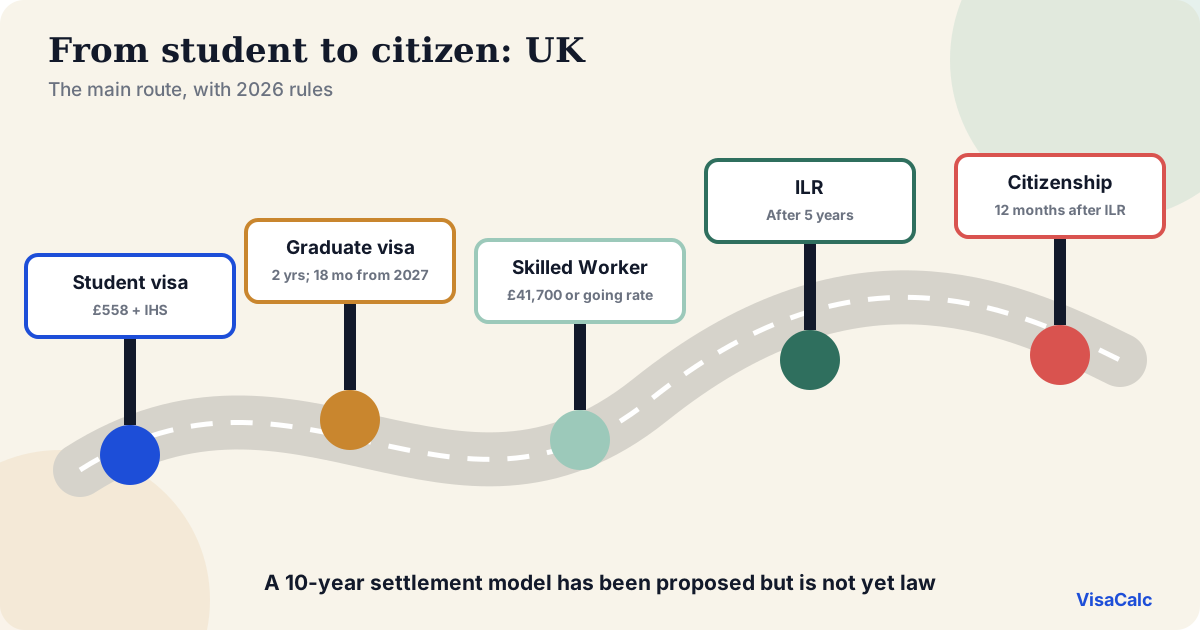
- Graduate visa shortened to 18 months (from 24) for applications from 1 January 2027; PhD holders keep 36 months
- Fair Work Agency established 7 April 2026 for worker-exploitation enforcement
🔶 Confirmed policy, rules not yet laid
| Pathway | Who qualifies |
|---|---|
| 3 years | Earnings above £125,140 in three of the last four years, or the Highest Talent Group (pending a Migration Advisory Committee report due by the end of December 2026) |
| 5 years | Earnings above £50,270 in three of the last five years; eligible health and education public service workers; partners and children of British citizens; BN(O) visa holders |
| 10 years | Default for everyone else meeting the mandatory requirements, including earnings of at least £12,571 a year (couples can combine to £25,142) |
| 20 years | Adults with a qualifying immigration breach, such as overstaying or working in breach, or whose use of public funds stops them qualifying sooner |
- Mandatory for everyone: good character with no criminal record, no unpaid government debt (NHS, tax, National Insurance or Home Office), B2 English, the Life in the UK test, and sustained earnings. Children, people aged 65+ and people with a qualifying condition are exempt from English, Life in the UK and earnings.
- Long Residence route will close (no date yet), and time on Student, Graduate and Visit routes will not count.
- Dropped: the 15-year route for jobs below RQF level 6, and reductions for volunteering or C1 English.
Who Is Protected
- Anyone who already holds ILR, and EU Settlement Scheme status holders (separate scheme)
- BN(O) visa holders, and partners and children of British citizens (5-year pathway)
- Care workers who entered or switched into the Health and Care route before May 2025: 5 years if they earn at least £25,000 and meet the route's conditions
- Certain health and education workers below RQF level 6 who arrived before May 2025: a one-off 5-year route
- Skilled Workers on the pre-April 2024 lower salary thresholds can keep extending on those terms until 2035
⚠️ There is no general protection for anyone else already in the UK: people without ILR when the new rules take effect will usually be assessed under them. Sources: Lewis Silkin, 3 November 2026; EIN, 3 November 2026.
❓ Frequently Asked Questions — UK ILR Earned Settlement 2026
Is UK ILR changing from 5 years to 10 years?
Yes, but not yet. On 2 November 2026 the Home Office published its response to the Earned Settlement consultation, confirming a 10-year baseline. The Home Secretary said the rules will start to be laid from the December 2026 immigration rules, with implementation expected during 2027. Until the new rules take effect, the existing 5-year route remains the law.
What are the Earned Settlement earnings thresholds?
Earnings above £50,270 in three of the last five years give a 5-year route, and above £125,140 in three of the last four years a 3-year route. Everyone else is on the 10-year baseline, which still needs earnings of at least £12,571 a year. Couples can combine earnings to meet a £25,142 household threshold.
Will the 10-year Long Residence route still exist?
No. The government confirmed the Long Residence route will close, but no closing date has been set. Time on temporary routes such as Student, Graduate and Visit will not count towards settlement under Earned Settlement.
Who is protected from the Earned Settlement changes?
Existing ILR holders keep their status, and the EU Settlement Scheme continues separately. BN(O) visa holders and partners and children of British citizens keep a 5-year pathway. Care workers who entered or switched into the Health and Care route before May 2025, and certain health and education workers who arrived before May 2025, keep 5 years if they meet the conditions. There is no general protection for other people already in the UK.
Has the English language requirement for ILR changed?
Yes, this part is already law. The Statement of Changes HC 1691, laid on 5 March 2026, raises the English requirement for settlement from B1 to B2 on many routes from 26 March 2027, including for people already on a settlement pathway.
What should I do if I am working towards UK ILR?
If you will reach 5 years before the new rules take effect, be ready to apply as soon as you qualify, because settlement applications are normally decided under the rules in force on the decision date. Keep payslips, P60s and an exact absence log, pass the Life in the UK test early, and plan for B2 English if you will apply on or after 26 March 2027. An IAA-regulated adviser can check your timing.
What This Means Practically, by Situation
If you reach 5 years before the new rules take effect: Apply as soon as you qualify. Settlement applications are normally decided under the rules in force on the decision date, so waiting could move you onto the 10-year baseline. Use our UK ILR date calculator to find your earliest application date and check your absences.
If you earn above £50,270: You are likely to keep a 5-year route if you have earned at that level in three of the last five years. Keep P60s and payslips for every year.
If you're newly arriving on a Skilled Worker visa: Plan for the new framework: 10 years by default, 5 or 3 with higher earnings, plus B2 English and a clean compliance record.
If you're comparing the UK against other destinations: The uncertainty itself is a data point. Countries with recently confirmed, stable rules — like Ireland's Critical Skills Employment Permit (2-year path to Stamp 4, confirmed) or Germany's Chancenkarte — currently offer more predictable timelines than the UK's ILR pathway during this transition period.
Sources
Figures on this page were checked against these official or primary sources on 30 October 2026.
If you're planning a UK Skilled Worker application, check your eligibility under current rules now.
🇬🇧 UK Skilled Worker Calculator 💰 Visa Fee Calculator⚠️ This is a fast-moving policy area. We will update this page as soon as draft Immigration Rules are laid before Parliament. For decisions affecting your specific case, consult an IAA-registered immigration adviser — do not rely solely on this or any other website for a major life decision.
How to cite this page
Chauhan, A. (VisaCalc). "UK ILR Earned Settlement Changes 2026 — What's Confirmed vs Proposed." VisaCalc. Last modified October 2026. https://visacalc.org/blog/uk-ilr-timeline-2026.html