Indian Engineer Canada Express Entry 2026 — Complete Guide

Indian engineers are one of the largest groups applying for Canada PR through Express Entry. With the right strategy, an Indian engineer can get PR in 12–24 months. Here is the complete, honest guide.
What CRS Score Do Indian Engineers Actually Get?
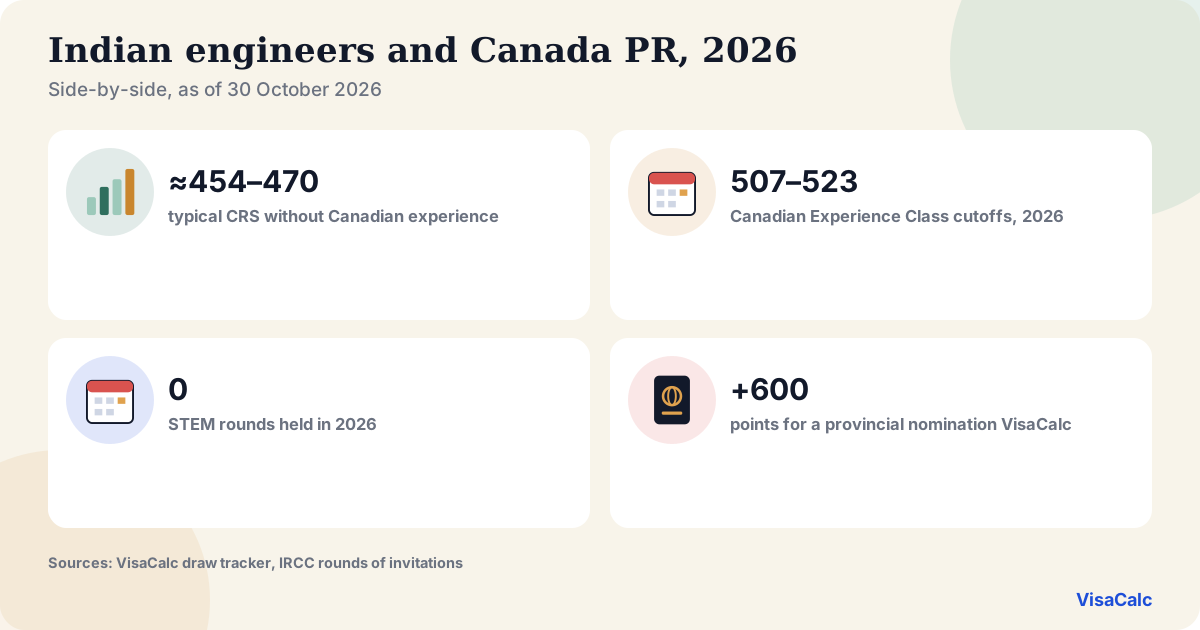
A typical Indian engineer aged 28–35 with a master's degree, IELTS around 7 (CLB 8–9) and 3+ years of work abroad, but no Canadian experience, scores roughly 430–470 CRS. In 2026 (to 28 October) IRCC held no all-program or STEM rounds. Invitations went to Canadian Experience Class (cutoffs 507–523), PNP, French (382–435) and a few other categories. Without Canadian experience, the realistic routes are a provincial nomination or French. See our draw tracker for every 2026 round.
| Profile Factor | Typical Points | Maximum Points |
|---|---|---|
| Age (28–32) | 100–105 | 110 |
| Master's degree | 135 | 150 (PhD) |
| IELTS 7.0 (CLB 9) | 29 per ability = 116 | 128 (CLB 10+) |
| 3+ years work exp (no Canada exp) | 0 Canadian exp points | 80 (5+ yrs Canada) |
| Foreign work transferability | 25 | 50 |
| Typical Total | ~480–510 | 1,200 |
The 3 Best Routes for Indian Engineers to Canada PR
Route 1: Express Entry via Canadian Experience (Fastest if You Can Work in Canada)
2026 reality check: IRCC ran no STEM-category or all-program rounds in 2026 (to 28 October). Most invitations without a nomination went to Canadian Experience Class candidates, with cutoffs of 507–523. Engineers who first come on a work permit or study permit and earn 1+ year of Canadian experience gain about 40–80 core points plus transferability points, and become eligible for CEC rounds.
Route 2: Provincial Nomination (Best for Below-500 CRS)
A nomination adds 600 CRS points, and 2026 PNP rounds have cut off at 697–805 including those points. Tech options have changed, though. BC's tech-targeted draws have not resumed since the BC PNP Tech Pilot ended, and BC now prioritises healthcare, early childhood educators and construction trades. The most tech-friendly provincial option in 2026 is Saskatchewan's new Tech Talent pathway, which covers 32 tech NOC codes.
Route 3: Ontario (OINP) with a Job Offer
Ontario's tech-only Express Entry draws ended with its old streams, and since 26 June 2026 all eight old streams have been replaced by the job-offer-based Ontario Workforce Priority stream. Ontario has the largest 2026 allocation (14,119 nominations), so an Ontario job offer is still valuable. Check the OINP site for current intakes.
How to Improve Your CRS Score as an Indian Engineer
- IELTS from 7.0 to 8.0 — Adds 12 points (3 points per ability × 4). Biggest single improvement. Take a targeted IELTS preparation course.
- Get Canadian work experience — If you are already in Canada on a work permit, 1 year of Canadian experience adds ~40 points. 5+ years adds 80 points.
- Learn French to NCLC 7 — Adds 50 points (with CLB 5+ English) plus second-language points, and makes you eligible for French rounds, which cut off at 382–435 in 2026.
- PNP nomination — e.g. Saskatchewan Tech Talent, or an employer-driven stream if you have a job offer. Adds 600 points.
Documents to Prepare Before Entering the Pool
- Educational Credential Assessment (ECA) — from WES or another designated organization; takes 4-8 weeks, start this first
- IELTS or CELPIP results — valid for 2 years from the test date; retake before entering the pool if yours will expire soon
- Work experience reference letters — on official company letterhead, listing job title, duties, hours/week, and salary, matching the NOC/TEER code you're claiming points for
- Proof of funds — bank statements showing liquid settlement funds (CAD $15,263 for a single applicant), unless you already hold valid Canadian work authorization
What It Costs an Indian Engineer to Immigrate
| Cost Item | Approx. Cost (CAD) |
|---|---|
| IELTS/CELPIP test | $300-350 |
| ECA (WES) | $230-280 |
| PR application + Right of PR fee | $1,595 |
| Biometrics | $85 |
| Medical exam | $250-350 |
| Fees subtotal | ~$2,460-2,660 |
| Required settlement funds (separate, must stay liquid) | $15,263 (single applicant) |
This is separate from any PNP application fee, which ranges from free in some Atlantic provinces to roughly CAD $1,500-2,000 in provinces like British Columbia or Ontario.
Frequently Asked Questions
Which Indian engineering degree scores the most CRS points?
The degree type (B.Tech, B.E., M.Tech) matters less than the degree level — a Master's degree scores significantly higher than a Bachelor's regardless of specialization, since CRS education points are based on credential level, not field of study.
Is the BC PNP Tech Pilot still running?
No. The Tech Pilot has ended and BC's tech-targeted draws have not resumed in 2026; BC now prioritises healthcare, early childhood educators and construction trades. Saskatchewan's new Tech Talent pathway (32 tech NOC codes) is the main tech-specific provincial option.
Do I need a job offer to enter the Express Entry pool?
No — a job offer is optional. From 3 November 2026 it adds 50, 70 or 100 CRS points only if the occupation is on IRCC's high-wage list (no LMIA needed); from March 2025 until then offers added none. Most successful Indian engineer applicants get invited without ever having a Canadian job offer, relying instead on strong core factors or a PNP nomination.
Sources
Figures on this page were checked against these official or primary sources on 30 October 2026.
Sources
Figures on this page were checked against these official or primary sources on 30 October 2026.
Calculate your exact CRS score and get a personalised improvement plan.
🇨🇦 Calculate My CRS Score 📈 Get My Improvement Plan