Canada vs UK Immigration 2026 — Quick Comparison

Worked example: government fees for one skilled worker
| Canada (Express Entry PR) | UK (3-year Skilled Worker) | |
|---|---|---|
| Application | C$990 + C$600 Right of PR Fee | £819 |
| Biometrics / health surcharge | C$85 | £3,105 (3 × £1,035) |
| Total | C$1,675, and the result is permanent residence | £3,924, and settlement needs another application after 5 years |
Canada and the UK are two of the most-compared immigration destinations — here's the quick version. For the full structural breakdown (why these systems work completely differently), see our complete UK vs Canada comparison.
The Core Structural Difference
| Factor | 🇨🇦 Canada Express Entry | 🇬🇧 UK Skilled Worker |
|---|---|---|
| Job offer required? | No — optional, adds bonus points | Yes, mandatory |
| What you receive on approval | Permanent residence, immediately | A temporary work visa (up to 5 years) |
| Selection mechanism | Government invites top-ranked CRS scores | Employer decides who to sponsor |
This is the same fundamental distinction covered in our full UK vs Canada comparison — Canada asks "how do you rank against everyone else?" while the UK asks "has an employer chosen you?" first.
Cost and Timeline
| Factor | 🇨🇦 Canada | 🇬🇧 UK |
|---|---|---|
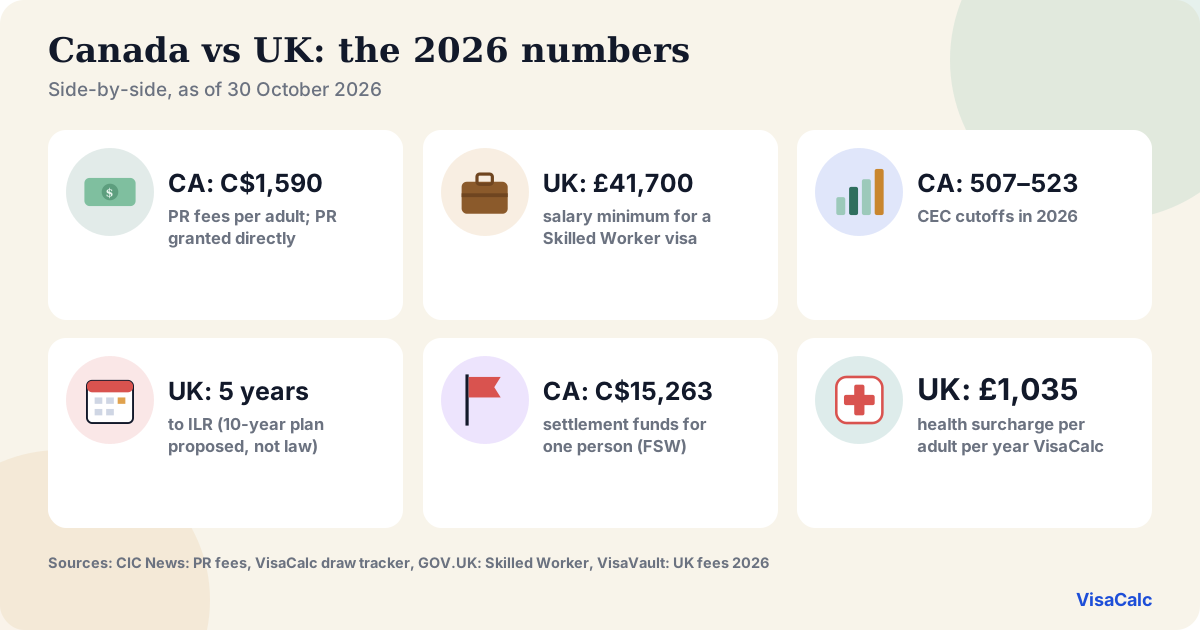
| Government fees (single applicant) | ~CAD $2,200-2,600 | ~£3,900-4,500 (3-year visa incl. IHS, following the April 2026 fee increase) |
| Time to permanent status | 6-18 months (PR granted directly) | 5+ years (then apply for ILR) |
| Required funds | ~CAD $15,263 liquid settlement funds (single applicant, Express Entry) | No locked-fund requirement if employer confirms coverage |
Bringing a Family: A Real Difference
Canada's Express Entry pathway lets you include a spouse and dependent children on the same application, with the spouse generally receiving open work rights once landed. The UK Skilled Worker route allows dependants too, but they pay their own visa fees and Immigration Health Surcharge on top of the main applicant's cost — for a family of three on a 3-year visa, this can roughly triple the total upfront government fees compared to a single applicant, a cost multiplier Canada's flat per-application fee structure doesn't carry in the same way.
The UK's New 10-Year Settlement Baseline
On 2 November 2026 the UK government confirmed its "Earned Settlement" model: the standard ILR qualifying period will rise from 5 to 10 years, with 5 years for people earning above £50,270 in three of the last five years and 3 years above £125,140. The rules start to be laid from December 2026, with implementation expected during 2027. One related change is already confirmed in law though not yet in force: a March 2026 Statement of Changes will raise the English requirement for settlement to CEFR B2, up from B1, effective 26 March 2027 - distinct from the B2 requirement for new work-visa applicants (Skilled Worker, Scale-up, HPI), which already took effect on 8 January 2026. Until the new rules take effect the existing 5-year route remains in force, but there is no general protection for people already in the UK, so anyone timing a UK move should plan around 10 years unless they will earn above £50,270. Canada's permanent residence, by contrast, is granted up front through Express Entry.
Which Should You Pursue?
- You have a UK job offer already → the UK route gets you working faster, even though permanent status takes longer.
- You want independence from a single employer → Canada's points system doesn't require anyone to choose you first.
- You want permanent status as fast as possible → Canada, decisively.
Sources
Figures on this page were checked against these official or primary sources on 30 October 2026.
Frequently Asked Questions
Is Canada or the UK easier to immigrate to?
Canada is generally more accessible for candidates without an existing job offer, since Express Entry lets you apply independently. The UK is more accessible if you already have a job offer in hand, since the process from offer to visa can take just a few weeks.
Which has better long-term prospects, Canada PR or UK ILR?
Both grant full settlement rights, but Canada's PR is granted immediately on approval while UK ILR requires 5 years on a temporary visa first. A UK Home Office proposal to extend this to 10 years was under review as of mid-2026 — see our UK ILR timeline guide for the current status.
Is it more expensive to bring a family to the UK than Canada?
Often yes — UK dependants pay their own visa fees and Immigration Health Surcharge on top of the main applicant's, which can roughly triple total upfront government fees for a family of three on a 3-year visa, a cost structure Canada's Express Entry doesn't carry in the same way.