Canada vs Germany for Indian Engineers 2026 — Which is Better?

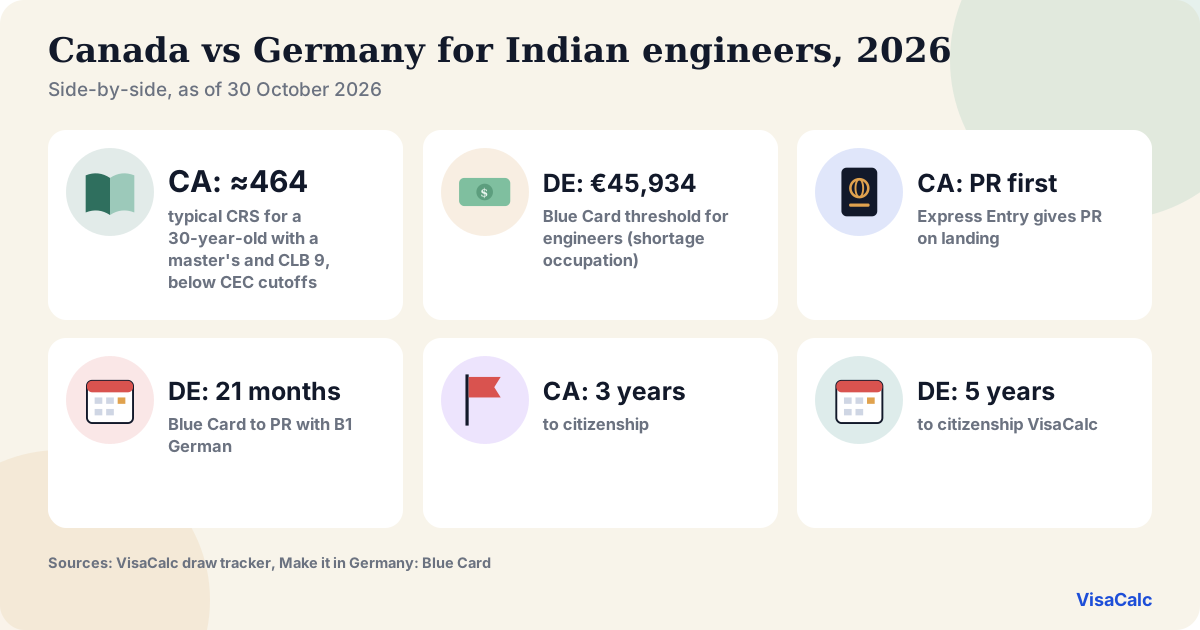
Worked example
| Scenario | Outcome |
|---|---|
| A 30-year-old civil engineer with a master's, CLB 9 English and 5 years of experience in India. | Canada: about 464 CRS, so a provincial nomination or Canadian experience is needed. Germany: a €50,000 offer clears the €45,934.20 Blue Card threshold, with PR possible after 21 months with B1 German. |
The Core Question
For an Indian engineer with 3–5 years experience and a technical degree, both Canada and Germany are genuinely achievable options in 2026. But they offer very different things. Here is the honest comparison.
Canada — Fast PR, English, Higher Salaries
Canada's biggest advantage is speed. An Indian engineer with IELTS 7.0+, a bachelor's degree, and 3+ years experience can build a CRS score of 440–470. That is below 2026 cutoffs for non-nominated candidates (CEC rounds needed 507–523, and there were no all-program rounds), so most will need a provincial nomination. Saskatchewan's Tech Talent pathway is the main tech-focused route in 2026, and with a nomination PR can come within 12–18 months.
Salaries in Canada for software/civil/mechanical engineers range from CAD $70,000–130,000+ in Toronto, Vancouver and Calgary. English is the primary language — no language barrier.
Germany — Free Education, EU Passport, Different Lifestyle
Germany's biggest advantage is the EU Blue Card to permanent residence in 21 months with B1 German (27 months otherwise) — faster than Canada in terms of PR timeline once you have a job. Add German citizenship after 5 years of residence (B1 German required; the 3-year fast track was repealed in October 2025), and you have access to all 27 EU countries.
Salaries are lower than Canada — €55,000–85,000 for engineers — but cost of living outside Munich/Frankfurt is also significantly lower. Public healthcare, free universities for your children, and excellent work-life balance.
If you don't have a job offer yet, Germany's Chancenkarte (Opportunity Card) lets you enter the country for up to 12 months to search for work, working part-time while you look — check your eligibility with the Chancenkarte points calculator. This is a meaningfully different starting point than Canada's Express Entry, which requires you to qualify and get invited before you can even enter the country to look for work.
Income Tax Comparison
| Income Level | 🇨🇦 Canada (Federal + Ontario, approx.) | 🇩🇪 Germany (approx.) |
|---|---|---|
| CAD/EUR 60,000 | ~20-24% effective | ~25-30% effective (incl. social contributions) |
| CAD/EUR 90,000 | ~25-28% effective | ~32-36% effective |
Germany's headline tax rates are higher once mandatory social insurance (health, pension, unemployment) is included, but this also funds a more comprehensive public safety net — free public healthcare with no separate premiums beyond payroll deduction, free public university tuition for your children, and generous parental leave. Canada's take-home pay is higher, but you're paying more out of pocket for equivalent coverage in some categories.
Total Immigration Cost
| Cost Item | 🇨🇦 Canada | 🇩🇪 Germany |
|---|---|---|
| Visa/permit fees | ~CAD $2,200-2,430 | ~€75-100 (Chancenkarte/Blue Card application) |
| Proof of funds required | CAD $15,263 (liquid, single applicant) | ~€13,092/year (Chancenkarte only; not required for Blue Card with job offer) |
Germany's visa fees are dramatically lower than Canada's if you already have a job offer and go the Blue Card route — the Chancenkarte's proof-of-funds requirement only applies to the job-search pathway, not to applicants who arrive with an offer in hand.
Frequently Asked Questions
Do I need to speak German to work as an engineer in Germany?
Many multinational and tech-adjacent engineering roles in Germany operate in English, especially in Munich and Berlin, but B1-B2 German significantly widens your job options and is required for permanent settlement and citizenship applications.
Can I get German PR without a job offer first?
Not directly — you need a qualifying job offer to convert the Chancenkarte into a work-based residence permit, which is the pathway toward PR. The Chancenkarte itself is a job-search visa, not a route to residency on its own.
Is the EU Blue Card the same as Canada's PR?
Not quite — the EU Blue Card is a residence permit tied to skilled employment that leads to permanent settlement (Niederlassungserlaubnis) after 21-27 months, comparable in effect to Canada's PR but arrived at through a different legal mechanism and initially more employer-dependent.
Side-by-Side Comparison
| Factor | 🇨🇦 Canada | 🇩🇪 Germany |
|---|---|---|
| PR Timeline | 12–18 months | 27 months (Blue Card) |
| Language Required | English only | B2 German for most jobs |
| Average Engineer Salary | CAD $85,000–120,000 | €55,000–80,000 |
| EU Passport | No | Yes (6–8 years) |
| Community (Indian) | Large — 1.8M Indians | Growing — 180,000 Indians |
| Climate | Cold winters | Mild European |
| Path for family | Included in PR | Family reunion visa |
Verdict
Choose Canada if: You want PR fast, you prefer English, you want higher salaries, or you are not willing to learn German.
Choose Germany if: You want an EU passport, you have time to learn German, you prefer European lifestyle, or you are a student who wants free tuition for your children.
Sources
Figures on this page were checked against these official or primary sources on 30 October 2026.
Use our free calculators to check your eligibility right now.
🇨🇦 Canada CRS Calculator 🌍 Which Country Quiz