🇬🇧 UK Maintenance Funds & Financial Requirements 2026
Every UK visa route has its own financial requirement — student maintenance funds, the family visa income threshold, and visitor visa "sufficient funds" all work differently. Here's exactly what each route needs.
Student Visa: Maintenance Funds
GOV.UK's financial evidence guidance says you must show enough money for your course fees plus living costs. For applications made on or after 11 November 2025, living costs are:
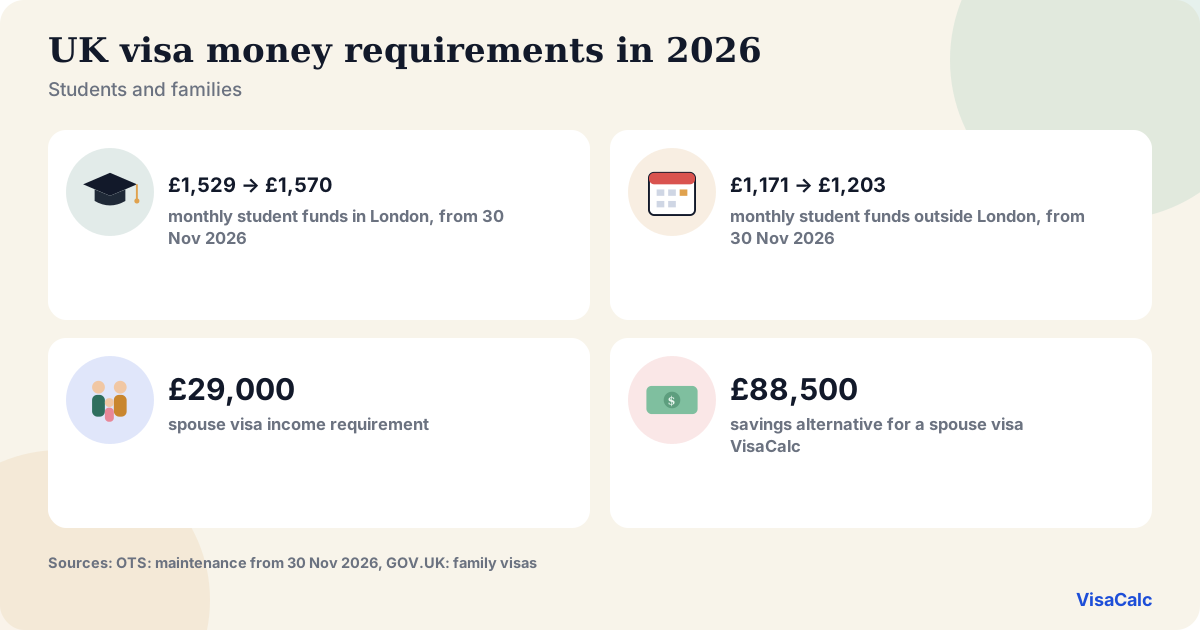
| Where you'll study | Monthly rate | Maximum (9 months) |
|---|---|---|
| Inside London | £1,529 | £13,761 |
| Outside London | £1,171 | £10,539 |
The rates were lower before that date (£1,483 and £1,136 from 2 January 2025, which total £13,347 and £10,224 for nine months), so any guide still quoting those totals is out of date. The living-cost figure is a maximum of nine months however long your course runs, and it sits on top of the course fees you still have to pay. For example, if you'll study in London and still owe £14,000 in fees after your deposit, you'd need £27,761 in the account (£14,000 plus £13,761).
Two timing rules catch people out. The money must have been in your account for 28 consecutive days, and the evidence must be from no more than 31 days before the date you apply. In practice that means working backwards from your application date: if you apply on 31 October, your statement's closing date must be no earlier than 30 September, so the 28-day holding period would run from 3 to 30 September. If you're relying on a student loan instead, GOV.UK asks for a loan letter dated no more than six months before you apply.
Family Visa: The £29,000 Minimum Income
GOV.UK says that if you apply as a partner, you and your partner usually need to show a combined income of at least £29,000 a year. This is a flat figure for applications on or after 11 April 2024, however many children are involved. Only UK-earned income counts for the applicant. Income can come from employment (before tax, shown by payslips or a P60), self-employment or a UK limited company, pensions, non-work income such as rent or dividends, and cash savings above £16,000. The evidence expected includes six months of payslips and bank statements, plus an employer's letter confirming job title, contract type, pay and how long that pay has applied; if you're self-employed, income is based on the last six months or more.
- Savings instead of income: savings count at a rate of 2.5 times any income shortfall, plus the first £16,000 which is ignored, so savings alone would need to be £88,500 (£16,000 plus 2.5 × £29,000), held for six months. If you earn £20,000, the £9,000 shortfall needs £38,500 in savings. See the Home Office financial requirement guidance for the detailed rules.
- Disability and carer benefits: if your partner receives certain benefits (including Personal Independence Payment, Disability Living Allowance or Carer's Allowance), there's no minimum income requirement, but you must show you can support yourselves without public funds.
- Earlier applicants extending: if you first applied as a partner before 11 April 2024 and you're extending, the combined income is £18,600, plus £3,800 for the first child and £2,400 for each further child (capped at £29,000).
The threshold has been under review. The House of Commons Library reports that the government kept £29,000 while considering a June 2025 independent review by the Migration Advisory Committee, which suggested a lower range of roughly £23,000 to £25,000 (summary). GOV.UK still states £29,000 as of 30 October 2026, so that remains the figure for new applications, but check before you apply because it could change.
If you can't meet it: GOV.UK says you may still be able to apply if you have a child in the UK who is a British or Irish citizen (or has lived here seven years) and it would be unreasonable for them to leave, or if refusing would breach your human rights. The cost of relying on that route is time: the earliest you can apply to settle is after ten years rather than five, and GOV.UK says applications from inside the UK that don't meet the financial and English requirements currently take about 12 months, compared with 8 weeks when they do.
Visitor Visa: Showing You Can Fund the Trip
Unlike student or family visas, the Standard Visitor visa has no published minimum balance. GOV.UK's eligibility rules say you must be able to show that you'll leave at the end of your visit, that you can support yourself and your dependants during the trip (or have funding from someone else), and that you can pay for your return or onward journey (or have funding from someone else). The visa costs £135 for up to six months, and depending on your nationality you may need an electronic travel authorisation or no visa at all, though you must still meet the same requirements at the border.
There is no separate standard for a parent or grandparent visiting a UK-based child: the same Standard Visitor rules apply, and funding from someone else, such as the relative you're visiting, can count if they can show they're able to support you. A large, unexplained deposit shortly before you apply invites the question of whether the money is genuinely yours and available to you. It's the same logic as the 28-day rule for students, so keep a clear record of where any large sum came from.
If You're Refused Because of Funds
What you can do depends on the route, and your decision letter is the authority. Visitor refusals don't carry a right of appeal, so the realistic option is a fresh application that fixes the specific gap. For student refusals, your letter says whether you can ask for an administrative review; if you can, note that making any other immigration application withdraws the request (see our work visa page for the deadlines and that trap). For partner visas, refusals under the family rules often carry a right of appeal, with deadlines of 14 or 28 days (see our family visa page). In all three cases the common thread is that the money has to be provable on paper in the right form and for the right period, so a refusal for timing or evidence reasons usually points to a better-prepared reapplication rather than simply resubmitting.
Where Funds Evidence Goes Wrong
- Using an old maintenance figure. Check the rate for your application date: £1,529 and £1,171 apply from 11 November 2025.
- A statement that's too old. The closing date must be no more than 31 days before you apply, so a statement that was fine last month can fail today.
- Funds not held for 28 consecutive days. The balance must stay at or above the requirement on every day of that period.
- Treating the £29,000 as the sponsor's income alone. GOV.UK describes it as the applicant's and partner's combined income, counting only the applicant's UK-earned income.
- Assuming the old child-based formula still applies. New applicants face a flat £29,000; the child top-ups only apply to earlier applicants extending.
- Unexplained large deposits. Document the source of any big recent sum, whichever route you're applying on.
Frequently Asked Questions
How much money do I need for a UK student visa?
For applications on or after 11 November 2025, £1,529 a month for a course in London or £1,171 a month outside London, for up to nine months (£13,761 or £10,539), plus the course fees you still owe. For applications made on or after 30 November 2026 the rates rise to £1,570 and £1,203 a month (£14,130 or £10,827). The money must be held for 28 consecutive days, with the evidence dated within 31 days of applying.
What is the UK family visa income requirement in 2026?
£29,000 a year in combined income for the applicant and partner, a flat figure for applications on or after 11 April 2024. Earlier applicants extending may be on £18,600 plus child top-ups. Savings can substitute: £88,500 on their own, held for six months.
Is there a fixed minimum bank balance for a UK visitor visa?
No. You must show you can support yourself during the trip and pay for your return or onward journey, or have funding from someone else to do so.
What happens if I can't meet the family visa income requirement?
You may still be able to apply if a British or Irish child in the UK would find it unreasonable to leave, or if refusal would breach your human rights. The earliest you could settle then is after ten years, and in-UK applications that don't meet the financial and English requirements currently take about 12 months.
Can a relative pay for my UK visit?
Yes. GOV.UK's Standard Visitor rules allow funding from someone else for both your living costs during the trip and your return or onward journey, provided they can show they're able to support you.