🇸🇬 Study in Singapore 2026 — Complete Guide
Complete guide to studying in Singapore — NUS and NTU (both QS top 15), real tuition with the Tuition Grant subsidy, student visa rules, work rights, and Asia's strongest graduate job market.

Worked example: what a 4-year degree costs
Tuition plus the official living-cost figure, fees held at 2026-27 levels and converted at 29 Oct 2026 rates:
| Scenario | Per year | 4-year total |
|---|---|---|
| Lowest fee we track: Nanyang Technological University | S$41,100 | S$164,400 ≈ ₹1.22 crore |
| Highest fee we track: National University of Singapore (most expensive programme) | S$61,650 | S$246,600 ≈ ₹1.83 crore |
Scholarships are not deducted, and costs usually rise each year. University pages with sourced 2026-27 fees: National University of Singapore, Nanyang Technological University.
🧭 Study in Singapore: the full journey
Every step in order, what the visa officer checks, what to pack to cut first-month costs, and how much part-time work really covers, with a calculator and short videos.
Why Study in Singapore?
Singapore offers two QS top-15 universities, English-medium teaching across every degree, and direct entry into Asia's strongest graduate job market — NUS and NTU graduates are actively recruited across tech, finance and biotech, with salaries that often exceed comparable roles in the applicant's home country by 2-3x.
Top Universities
National University of Singapore (NUS)
QS #10 (2027), Asia's top-ranked university, NUS Merit Scholarships cover up to 100% tuition
Nanyang Technological University (NTU)
QS #12 (2027), strong engineering and business programmes, the Nanyang Scholarship is highly competitive
See the full Singapore university tier breakdown →
Tuition Fees
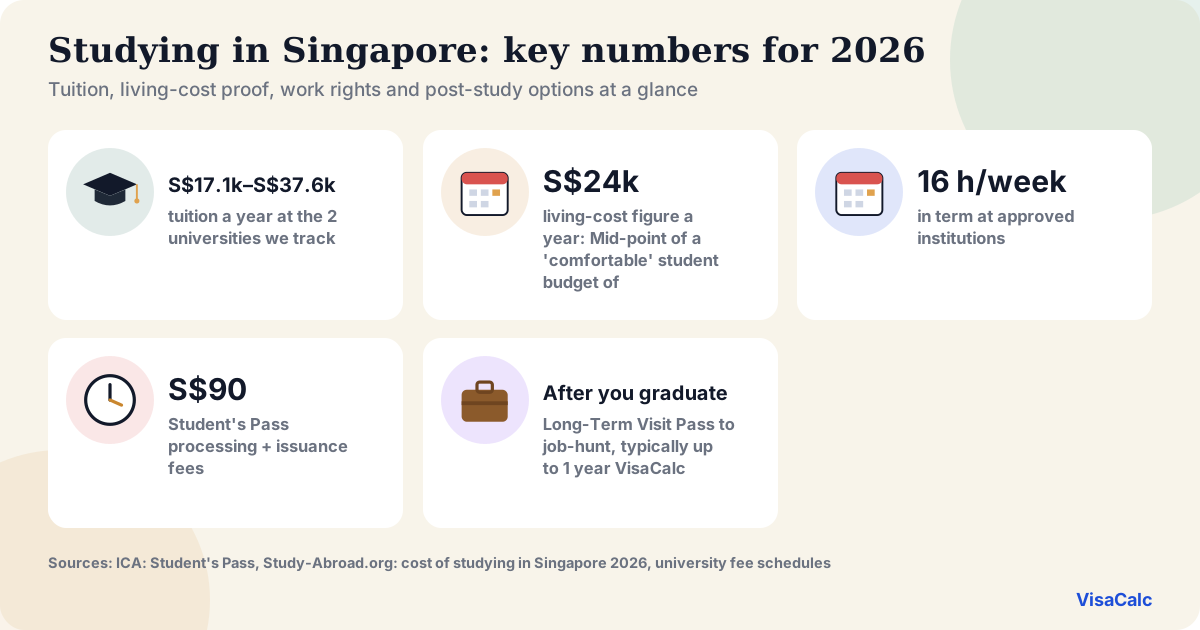
SGD $17,000-50,000/year — the Tuition Grant (MOE subsidy, roughly 50% of full fees) is available to international students but comes with an important condition: recipients commit to working for a Singapore-registered company for 3 years after graduation.
See the full real-cost breakdown & savings strategies →
Living Cost
SGD $600-1,200/month — on-campus dormitories from SGD $200/month are significantly cheaper than private housing and the preferred option for most international students; apply for campus housing immediately after your offer letter.
Scholarships
NUS Merit Scholarships (up to 100% tuition + SGD $1,000-2,000/month, covers ~2% of intake), Nanyang Scholarship (full tuition + SGD $1,200-1,800/month, ~50 awarded annually), A*STAR Scholarships (government R&D agency, full tuition + stipend + lab internship), ASEAN Scholarships (full tuition + stipend for regional applicants including Indian nationals in some categories).
Student Visa
Student's Pass: Your university submits your application through the SOLAR+ system after you accept your offer. Processing typically takes 2-6 weeks (up to 6-8 weeks during peak June-August intake periods) — apply at least 3-4 months before your course start date.
Full Singapore student visa guide →
Work While Studying
16 hours/week during term at approved institutions (NUS, NTU, SMU, SUTD, SIT, SUSS), unlimited hours during official vacation periods — embedded automatically in the Student's Pass, no separate work permit needed.
Post-Study Work Visa
Graduates apply for an Employment Pass once they secure a qualifying job offer — Singapore doesn't have a broad no-offer-needed post-study visa like the UK's Graduate Route, so job hunting typically needs to conclude before or very close to your Student's Pass expiring.
PR / Permanent Residence Pathway
Graduating from NUS, NTU or SMU is viewed favourably by immigration assessors, and combined with an Employment Pass and CPF contributions in an in-demand sector (technology, finance, biomedical sciences), puts graduates in a genuinely strong position for eventual PR.
Related Calculators
Related Guides
❓ Frequently Asked Questions
What does the Tuition Grant 3-year bond actually mean?
If you accept Singapore's Tuition Grant (which cuts your fees roughly in half), you're committing to work for a Singapore-registered company for 3 years after graduation. Breaking this bond typically requires repaying the subsidised amount — factor this into your decision if you're not sure you want to stay in Singapore long-term.
Is Singapore's post-study work path as generous as the UK or Canada?
No — this is an important honest distinction. Singapore doesn't offer a broad, no-job-needed post-study visa like the UK's Graduate Route or Canada's PGWP. Most graduates need to secure an Employment Pass-qualifying job offer before or shortly after their Student's Pass expires.
How much more can I expect to earn in Singapore versus back home?
Substantially more in most cases — CS graduates from NUS/NTU report starting salaries of SGD $5,200-7,500/month, which for many international students represents 2-3x what an equivalent role would pay in their home country.
Explore more study destinations.
🌍 Study Abroad HubThis guide is for informational purposes only and does not constitute immigration or admissions advice. Rules change frequently — always verify current requirements with official government and university sources before making decisions.