🇦🇺 Australia Work Visa Types Compared 2026
The Skills in Demand visa replaced the Temporary Skill Shortage visa on 7 December 2024 — here's how its streams compare, what the 1 July 2026 fee and salary changes mean, and when a points-tested visa beats employer sponsorship.

Worked example: sponsorship or points?
| Scenario | Route |
|---|---|
| A software engineer, 34, with a Sydney job offer of A$95,000 and 70 points | The offer clears the A$79,499 Core Skills threshold for a 482; after two years with the sponsor the employer can nominate them for a 186. In parallel they can keep a 189/190 Expression of Interest open. |
Skills in Demand Visa: Streams, Pay Floors and What Isn't Live
The Skills in Demand visa (subclass 482) replaced the Temporary Skill Shortage visa on 7 December 2024. The Department of Home Affairs' own pages load dynamically, so the figures below come from practitioners' summaries of the Department's published settings; confirm them on the official subclass 482 page before you lodge.
| Stream | Salary floor (nominations from 1 July 2026) | Occupation rule |
|---|---|---|
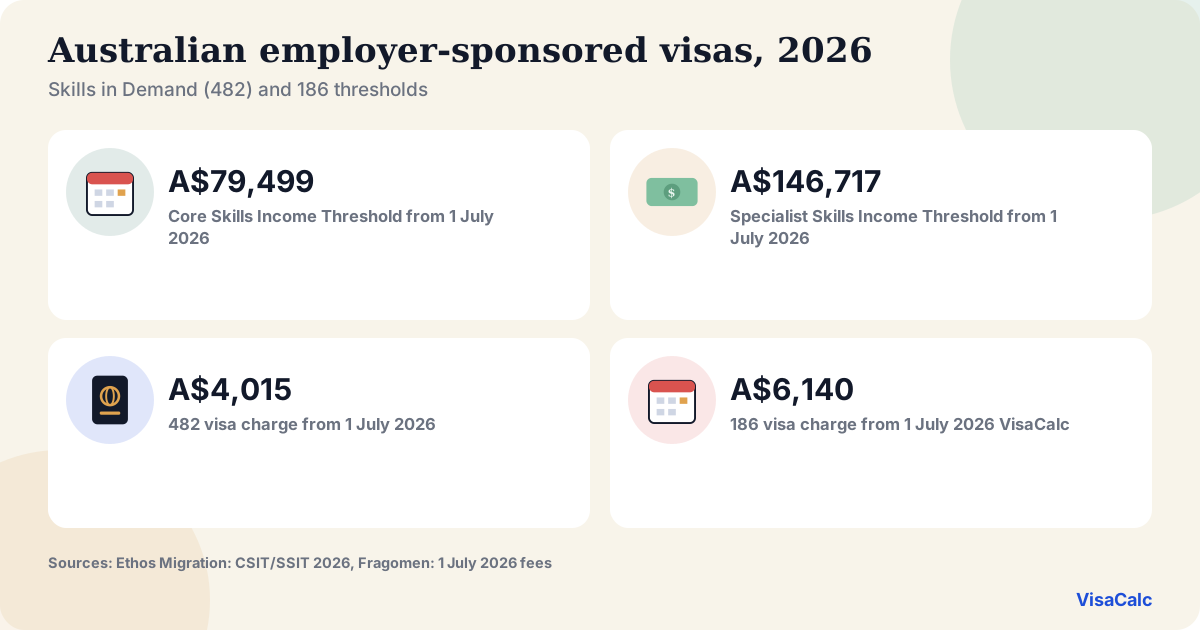
| Specialist Skills | A$146,717 (up from A$141,210) | No occupation list, but limited to ANZSCO major groups 1, 2, 4, 5 and 6, which excludes trades, machinery operators and labourers |
| Core Skills | A$79,499 (up from A$76,515), indexed each 1 July | Occupation must be on the Core Skills Occupation List |
| Labour Agreement | Set by the agreement | Defined by the agreement |
Thresholds as published by Home Affairs on 1 July 2026, per this summary and this one. The nominated pay must also meet the Annual Market Salary Rate for the job and location, whichever figure is higher.
You may see guides listing a third “Essential Skills” stream for lower-paid roles. Practitioners describe it as still under development or never legislated, so don't plan around it. Other settings to know: the worker needs at least one year of relevant full-time experience in the past five years, and Competent English, which for most applicants means IELTS 5.0 in each band or an equivalent test score (older guides quoting a 4.5 band minimum describe the previous visa). The Home Affairs occupation list pages show whether an occupation is eligible. The visa application charge rose from A$3,210 to A$4,015 on 1 July 2026 and isn't refundable.
The visa sits on a direct route to permanent residence: after two years of full-time work with your sponsor (reduced from three), your employer can nominate you for the Employer Nomination Scheme (subclass 186) through its Temporary Residence Transition stream (summary). That nomination isn't automatic: your employer has to choose to make it.
Points-Tested vs. Employer-Sponsored: Which Is Right for You?
The 189 (Skilled Independent) is the “gold standard”: permanent residence with no sponsor, no employer ties and no location restrictions, applied for through the points-based SkillSelect system. The 190 (State Nominated) works the same way but needs state nomination (adding 5 points) and a commitment to live in that state, usually for about two years. Neither requires a job offer. By contrast, the Skills in Demand visa needs an employer to sponsor you, with no points test, but you're tied to that employer's role. Many applicants run both strategies in parallel, lodging a 189/190 Expression of Interest while also seeking sponsorship as a backup.
Fees changed sharply on 1 July 2026, by roughly 25% for most skilled visas (Provisa summary): the 189 is now A$6,135, and the 190, 491 and 186 are A$6,140 each, up from A$4,910. Because the charge is non-refundable, a refused application means paying the new, higher fee again to reapply (First Migration Service).
The Regional Trade-off (491 and Then 191)
The Subclass 491 gives 15 bonus points in exchange for living and working in a designated regional area (essentially anywhere outside Sydney, Melbourne and Brisbane) for at least three years. You then apply for the permanent Subclass 191, whose charge for the regional provisional stream is A$630 (up from A$505) compared with A$6,140 for the 491 itself. The 191 requires three years on the 491 or 494 while complying with its conditions, and Australian Taxation Office notices of assessment for three income years out of the five.
Be careful with the income test, because sources disagree on it. Many practitioners state a minimum taxable income of A$53,900 in each of those years (one summary), while a Home Affairs update reported by Visa Envoy said no minimum income threshold was in place from June 2023, so check the current rule on Home Affairs before relying on either. Either way, the safer reading is to treat the three tax-assessed years as a hard requirement, and note that time living or working outside a regional area can breach the 491's conditions and put the 191 at risk.
If Your Job Ends or a Visa Is Refused
Losing your sponsor on a 482. Summaries of the current rules say that if your employment ends you generally have up to 180 days at a time, and 365 days in total across the visa, to find a new approved sponsor, apply for a different visa, or leave (summary). A new employer has to lodge a new nomination for you; starting work for someone who hasn't done so breaches your visa conditions. Time with the old employer still counts towards the two years needed for the 186. The 180 days are a hard limit, not a cushion, so start looking immediately.
A refusal. The Administrative Review Tribunal (ART), which replaced the Administrative Appeals Tribunal on 14 October 2024, reviews many visa refusals and cancellations, and your refusal letter says whether you can apply. The deadline is short and the ART generally can't extend it: practitioner sources variously cite 21 or 28 days for onshore decisions and up to 70 days for some offshore or sponsor-related ones, so use the date on your own notice. The review fee is currently about A$3,700 (ausimmi; One Planet Migration Law), with a reduced fee for hardship. If the ART affirms the refusal, judicial review in the Federal Circuit and Family Court is a further, narrower option with its own short deadline. Since visa application charges are non-refundable, weigh a review against simply fixing the weakness and reapplying.
What Closed, What's New
The Business Innovation and Investment Program (the 188/888 visas), Australia's old investor route, closed to new applications on 31 July 2024. Its replacement, the Subclass 858 National Innovation Visa, launched in December 2024 and is invitation-only and achievement-based, replacing both the investor program and the Global Talent visa (summary). There is no “buy your way in” option left.
Where Applicants Go Wrong
- Planning around an “Essential Skills” stream. It isn't an operating stream, so build your plan on Core Skills, Specialist Skills or a labour agreement.
- Assuming the old English rule. The standard is IELTS 5.0 in each band, not 4.5.
- Reading “no occupation list” as “any job”. The Specialist Skills stream still excludes trades, machinery operators and labourers.
- Budgeting with pre-July 2026 fees. Most skilled visas rose by about 25% on 1 July 2026.
- Treating the 491 as a guaranteed route to PR. You need three regional years, compliance with the conditions and the tax records to show for it.
- Waiting to look for a sponsor. After a job ends, the 180 days start running straight away.
Frequently Asked Questions
What replaced the old Temporary Skill Shortage (TSS) visa?
The Skills in Demand visa (subclass 482), launched on 7 December 2024. Its operating streams are Core Skills (A$79,499 from 1 July 2026, occupation must be on the Core Skills Occupation List), Specialist Skills (A$146,717, no occupation list but limited to certain occupation groups) and Labour Agreement. A proposed Essential Skills stream is not operating.
Do I need a job offer for the Subclass 189 visa?
No. The 189 (Skilled Independent) is entirely points-based, with no employer sponsor, no job offer, and no state or regional location requirement.
Is there still an investor visa to Australia?
No. The Business Innovation and Investment Program closed to new applications on 31 July 2024. The Subclass 858 National Innovation Visa launched in December 2024, but it is invitation-only and talent-led rather than investment-led.
What happens if I lose my job on a Skills in Demand visa?
You generally have up to 180 days at a time, and 365 days in total across the visa, to find a new approved sponsor, apply for a different visa or leave Australia. A new employer must lodge a new nomination before you start work for them.
How much do Australian skilled visas cost?
From 1 July 2026: A$4,015 for the 482 Skills in Demand visa, A$6,135 for the 189, and A$6,140 for the 190, 491 and 186, each up roughly 25%. The 191 regional provisional stream is A$630. Charges are non-refundable.
Can I challenge a visa refusal in Australia?
Often yes, through the Administrative Review Tribunal if your refusal notice says you can. Deadlines are short and generally can't be extended, so use the date on your notice. The review fee is around A$3,700.