🇦🇺 Australia Healthcare & Nursing Visa Pathways 2026
Healthcare is the single most consistently PR-accessible sector in Australia — driven by an aging population and a nursing shortage that shows no sign of easing.

Why Healthcare Leads the Occupation Lists
Registered nursing and related health occupations appear on the skilled occupation lists that matter for both points-tested and employer-sponsored visas, and attract state nomination from most states and territories. Which list applies depends on the visa. Since 7 December 2024 the 456-occupation Core Skills Occupation List covers the Skills in Demand (482) Core Skills stream and the 186 Direct Entry stream, while the older Medium and Long-term Strategic Skills List and related lists still apply to the points-tested 189, 190 and 491 (summary). Check your exact occupation code on the Department's skilled occupation list pages for the visa you intend to use. Occupation codes and lists are reviewed, so don't rely on a list from a guide that predates your application.
What Nurses Are Paid
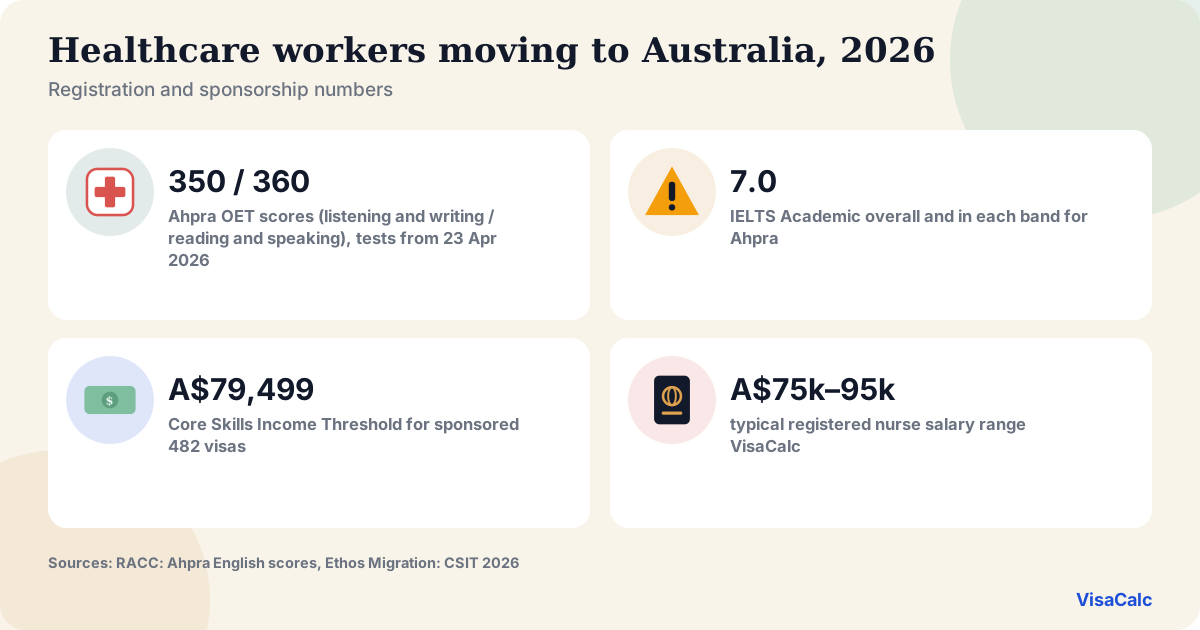
The legal floor is set by the Nurses Award. From 1 July 2026 (after a 4.75% rise), the award sets a Registered Nurse Level 1, pay point 1 minimum of A$1,219.50 a week, or A$32.09 an hour, roughly A$63,400 a year on a 38-hour week, with an enrolled nurse at A$30.00 an hour. Actual pay is often above this, because public-sector enterprise agreements, experience, shift loadings and regional incentives all add to it, and aged-care nurses have been the subject of a separate Fair Work Commission increase, so check the current award schedule. Overseas-trained nurses are paid on the same basis as locally trained ones once registered, according to their classification and experience. Treat any single salary range in a guide with caution, including older versions of this page, since it depends heavily on the employer, state and setting.
Visa Pathways for Healthcare Workers
- Skilled Independent (189) and State Nominated (190): points-tested, no employer sponsor needed, permanent residence from the start. See our points calculator.
- Employer Nomination Scheme (186): needs an approved sponsor and typically three years of relevant experience, AHPRA registration and being under 45 for the Direct Entry stream. Workers on a 482 can reach it through the Temporary Residence Transition stream after two years with their sponsor.
- Regional route (494 then 191, or 491 then 191): targets regional areas and ends in permanent residence after three years in a designated region. The older 187 regional visa is closed to new applicants (summary).
- Skills in Demand (482): employer-sponsored; the Core Skills stream floor is A$79,499 from 1 July 2026. If your job ends you generally have 180 days to find a new sponsor; see our work visa page for the rules and fees.
AHPRA Registration: The Step That Decides Your Timeline
Nurses and midwives must be registered with the Nursing and Midwifery Board of Australia through AHPRA before they can legally practise, whichever visa they use. Overseas-qualified nurses start with a self-check that places them in Stream A, B or C. Most (a Philippines-trained nurse, for example, per one adviser) land in Stream B and must complete the Outcomes-Based Assessment: a multiple-choice exam (the NCLEX-RN) and a practical OSCE held in person in Adelaide. Commonly cited costs are a non-refundable A$640 assessment fee, an OSCE fee of about A$4,000 and an ANMAC skills assessment of about A$515 for points-tested visas (one adviser summary; another), with end-to-end timelines of roughly 9 to 18 months before visa processing (estimate). Confirm every fee on AHPRA's own site, since they change.
The English standard changed recently, and older guides are wrong about it. For tests taken on or after 23 April 2026, practitioner summaries of the revised standard list: IELTS Academic 7 overall with 7 in listening, reading and speaking and 6.5 in writing; OET 350, 360, 350 and 360 across listening, reading, writing and speaking; PTE Academic 63 overall; and TOEFL iBT 91 (summary). For tests taken earlier, the bar was 7.0 in every IELTS band, which is why guides saying a single 6.5 in Writing fails the application describe the old rule. Check AHPRA's accepted-tests page for sitting, validity and retake rules before you book. Separately, higher scores earn migration points: IELTS 8.0 in every band (“Superior English”) is worth 20 points.
Aged Care: A Distinct, High-Demand Pathway
Aged care is one of the clearer routes to Australian permanent residence, through employer sponsorship, state nomination and regional programs, particularly for nurses and experienced carers. Practitioner summaries list aged and disabled carers on the Core Skills Occupation List, which opens the 482 Core Skills stream and the 186 Direct Entry stream, subject to the experience, age and pay requirements for those visas. There is no single salary threshold specific to aged care; the 482 pay floors and the market salary rate for the role and location apply.
When Registration or a Job Falls Through
- An English shortfall. Because the standard turns on individual section scores, a single weak section can hold up your registration. Check which sittings and retakes AHPRA allows before you re-sit.
- Struggling with the assessment stage. The OBA is the most expensive and time-consuming step, so budget for the possibility of a resit and don't treat the A$640 and ~A$4,000 figures as the whole cost.
- Losing your sponsor. On a 482 you generally have 180 days at a time (365 in total) to find a new approved sponsor before you must leave or change visa.
- A visa refusal. Review rights run through the Administrative Review Tribunal with short, strict deadlines; see our work visa page.
Where Healthcare Applicants Go Wrong
- Delaying AHPRA registration. It sets your timeline, and employers want to see it progressing.
- Relying on an out-of-date English rule. The standard for tests taken from 23 April 2026 differs from what older guides state.
- Using the wrong occupation list. Points-tested visas and the 482/186 use different lists.
- Planning around a closed visa. The 187 no longer accepts new applications; the regional route is the 494 or 491.
- Overlooking regional postings. They can pay more and speed up the visa, not just serve as a fallback.
- Missing the 186 age cutoff. The Direct Entry stream typically requires being under 45.
Frequently Asked Questions
Do international nurses need AHPRA registration to work in Australia?
Yes. Registration with the Nursing and Midwifery Board of Australia through AHPRA is mandatory before you can legally practise nursing, regardless of visa. Most overseas-qualified nurses complete the Outcomes-Based Assessment, which includes a multiple-choice exam and an OSCE held in Adelaide.
What do nurses earn in Australia?
The Nurses Award sets a minimum of A$1,219.50 a week (A$32.09 an hour) for a Registered Nurse Level 1 at pay point 1 from 1 July 2026, about A$63,400 a year. Actual pay is often higher depending on the employer, state enterprise agreement, experience, shift loadings and regional incentives.
What English score do nurses need for AHPRA?
For tests taken on or after 23 April 2026, IELTS Academic 7 overall with 7 in listening, reading and speaking and 6.5 in writing, or OET 350/360/350/360 or PTE Academic 63 overall, according to practitioner summaries of the revised standard. Earlier tests required 7.0 in every IELTS band. Confirm on AHPRA's site before booking.
Is aged care a genuine pathway to Australian PR?
Yes, through employer sponsorship, state nomination and regional programs, particularly for nurses and experienced carers. Aged and disabled carers appear on the Core Skills Occupation List, subject to the experience, age and pay requirements of the visa.
How long does it take to register as an overseas nurse?
Practitioner estimates are roughly 9 to 18 months end to end, including English testing, AHPRA assessment and visa processing. The exact time depends on your stream, exam availability and visa subclass.