🇦🇺 Australia Partner & Family Visa Guide 2026
The partner visa (820/801 onshore, 309/100 offshore) is one of Australia's most-applied-for and most complex visas — and the parent visa queue has become so long that new applicants are looking at a wait measured in decades.
Worked example
| Scenario | Outcome |
|---|---|
| A couple lodges an onshore partner visa (820/801) in November 2026. | They pay A$11,710 up front. Half of applications reach the temporary-stage decision within about 22 months, so a grant around late 2028 is typical; the permanent stage is assessed about two years after lodgement. |
Partner Visa: Onshore (820/801) vs. Offshore (309/100)
If you're already in Australia and your partner is an Australian citizen, permanent resident or eligible New Zealand citizen, you apply onshore for the 820/801. If you're outside Australia, the equivalent is the 309/100. Both work the same way: one combined application and one fee, with the temporary stage granted first and the permanent stage assessed roughly two years after you lodged. Married, de facto and same-sex couples are eligible on the same terms.
| Item | Detail |
|---|---|
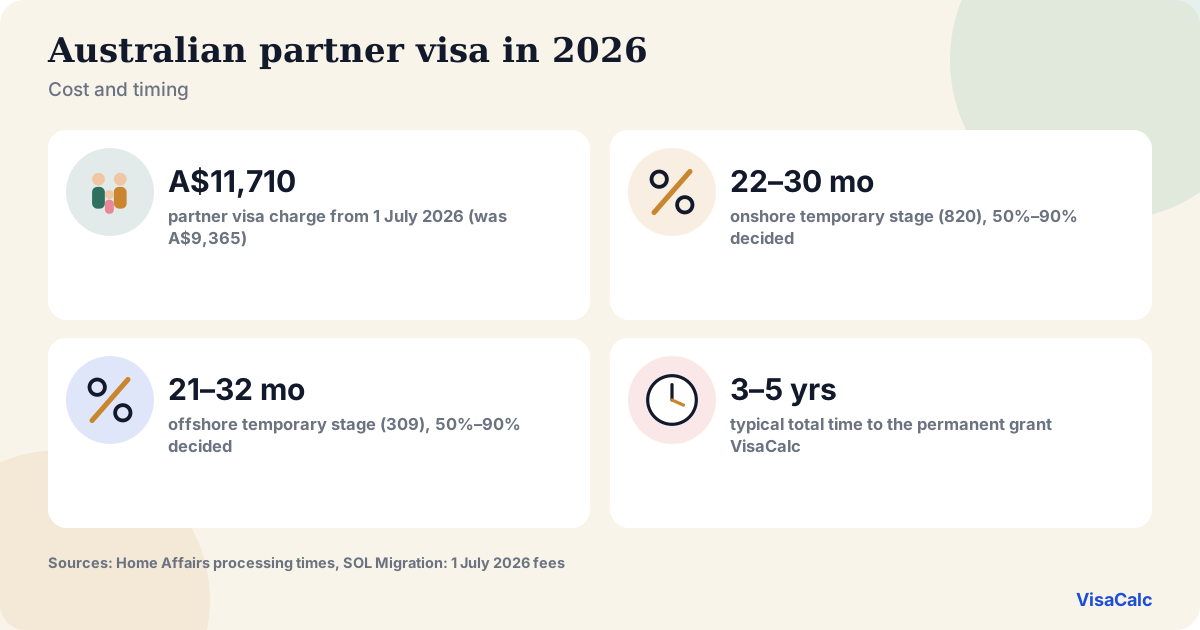
| Combined fee (from 1 July 2026) | A$11,710, up from A$9,365 (summary; another). Non-refundable. |
| Temporary stage, onshore (820) | Home Affairs' September 2026 global figures: 50% decided within about 22 months, 90% within about 30 |
| Temporary stage, offshore (309) | About 21 months for 50% and 32 months for 90% |
| Permanent stage (801 / 100) | Assessed about two years after original lodgement; 801: 8 to 19 months, 100: 9 to 21 months (50% to 90%) |
| Total time to permanent grant | Commonly 3 to 5 years in practice |
Processing figures are the Department's published percentile times as summarised by Widen Migration (September 2026). Home Affairs updates them monthly, and earlier 2026 summaries showed shorter waits (about 16 to 20 months at the 50% mark), so times have been lengthening. Use the Department's own processing-time tool for your lodgement date.
Onshore applicants get a Bridging Visa A after lodging, which keeps them lawfully in Australia once their current visa expires. On English, the position is genuinely unsettled across sources. Home Affairs proposed a functional-English requirement for the second (permanent) stage, with a “reasonable effort to learn English” route such as about 500 hours of free classes under the Adult Migrant English Program (consultation paper), but several 2026 practitioner guides say there is still no mandatory English test to grant the temporary visa (example). Check the current requirement for your stage rather than assuming either way.
Evidence: The Four Pillars
Applications are assessed against four categories of evidence: Financial (joint accounts, shared expenses), Social (how others see the relationship, such as photos, invitations and statements from friends and family), Household (shared address, bills, joint responsibilities) and Commitment (long-term plans together). Consistency across every form and document matters enormously: a mismatched date between your relationship statement and a lease agreement is a genuinely common reason for delay or refusal. The case officer is testing whether the relationship is genuine and continuing, so evidence that builds up over time, rather than a pile of documents gathered at the last minute, tends to carry more weight.
Parent Visas: A Realistic Decades-Long Wait
The non-contributory Parent visa (103) queue is the problem. As of early 2026, summaries of the Department's queue releases show applications lodged around 2013 to 2014 being released, and new lodgements are estimated to face a wait of 30 years or more (Questra; Migratio). The realistic alternatives are:
- Contributory Parent visa (143): a total government charge of about A$49,900 per parent from 1 July 2026, paid in two instalments (about A$6,300 at lodgement and A$43,600 before the visa is granted). Practitioner summaries put the wait at roughly 12 to 15 years on current queue data, and the Department no longer quotes a fixed time (Asia Pacific Group; Widen). Older guides quoting 4 to 6 years are out of date.
- Sponsored Parent (Temporary) visa (870): no path to permanent residence, but far cheaper and quicker, at around A$5,700 for three years or A$11,500 for five years before the 1 July 2026 increase (most charges then rose about 25%, so confirm the current figure). The sponsor has to be approved first, and a parent on the 870 has no work rights or Medicare access. Many families run an 870 alongside a permanent application.
The cost gap is the real decision: roughly A$50,000 for a permanent visa on a 12-to-15-year clock, against a few thousand dollars a year for a temporary stay that never turns into residence.
When a Partner or Parent Application Hits Trouble
- Travelling on a Bridging Visa A. A Bridging Visa A ceases when you leave Australia and doesn't let you return. Because the 820 generally has to be decided while you're in Australia, leaving without a Bridging Visa B (which permits re-entry) can leave you unable to come back and put the onshore application at risk. Apply for the BVB before any trip.
- Visa conditions that block an onshore application. Conditions such as 8503 (“no further stay”) on a visitor or other visa can prevent lodging the 820/801 from inside Australia unless the condition is waived, which is only possible in limited circumstances.
- A refusal. Many partner visa refusals can be taken to the Administrative Review Tribunal, which replaced the AAT on 14 October 2024, if your refusal notice says you can. Deadlines are short and generally can't be extended; practitioner sources cite figures from 21 to 70 days depending on the decision, so use the date on your own notice. The review fee is currently about A$3,700 (ausimmi; One Planet). Because the visa charge is non-refundable, a refusal followed by a fresh application means paying the higher fee again, so weigh review against reapplying with fixed evidence.
Where Family Applications Go Wrong
- Inconsistent dates across forms. Relationship dates, address history and sponsor details must match across every document.
- Treating the standard parent visa as a realistic option. With 2013 to 2014 applications being released, weigh the contributory 143 or the temporary 870 instead.
- Quoting old processing times. The temporary partner stage is now about 22 to 30 months onshore at the 50% to 90% marks, not 12 to 24.
- Leaving Australia on a Bridging Visa A without a BVB.
- Budgeting with last year's fees. The partner visa rose to A$11,710 on 1 July 2026.
Frequently Asked Questions
How long does an Australian partner visa take?
Typically 3 to 5 years from lodgement to the permanent grant. Home Affairs' September 2026 global times put the onshore temporary stage (820) at about 22 months for 50% of cases and 30 months for 90%, and the permanent stage (801) is assessed about two years after lodgement.
How long is the wait for an Australian parent visa in 2026?
For the non-contributory Parent visa (103), new lodgements face an estimated wait of 30 years or more. The Contributory Parent visa (143) costs about A$49,900 per parent from 1 July 2026 and practitioner summaries put the wait at roughly 12 to 15 years.
Do I need English for an Australian partner visa?
Sources differ. Home Affairs proposed a functional-English requirement at the permanent stage, with classes under the Adult Migrant English Program as an alternative, but several 2026 guides say there is no mandatory English test to grant the temporary visa. Check the current rule for your stage.
How much does an Australian partner visa cost?
A$11,710 combined for the temporary and permanent stages, from 1 July 2026 (up from A$9,365). The charge is non-refundable.
Can I travel while my onshore partner visa is processing?
Only with a Bridging Visa B. A Bridging Visa A ceases when you leave Australia and doesn't let you return, so apply for a BVB before any trip.